
Single Payer Myths & Myth Busters
Download, Print, Share Myth Buster Flyers
“Millions of people who work in healthcare will lose their jobs.”
"It’s socialized medicine, a government takeover of healthcare"
"There are no bills in Congress for National Improved Medicare for All"
"We will still have some medical debt and bankruptcy"
42 Myths for 42 Years
“Now is not the time to pass National Improved Medicare for All. We’ve got other problems.”
Now is exactly the time. Lifelong healthcare is the foundation of fairness, economic dignity, and equality. Every so often, things get so bad that a chance opens to change healthcare from a system built on profit to one built on need. That moment is now. Only National Improved Medicare for All (bill H.R. 3069 in the United States House of Representatives) guarantees care to everyone in the United States, with no barriers, gaps, or denials.
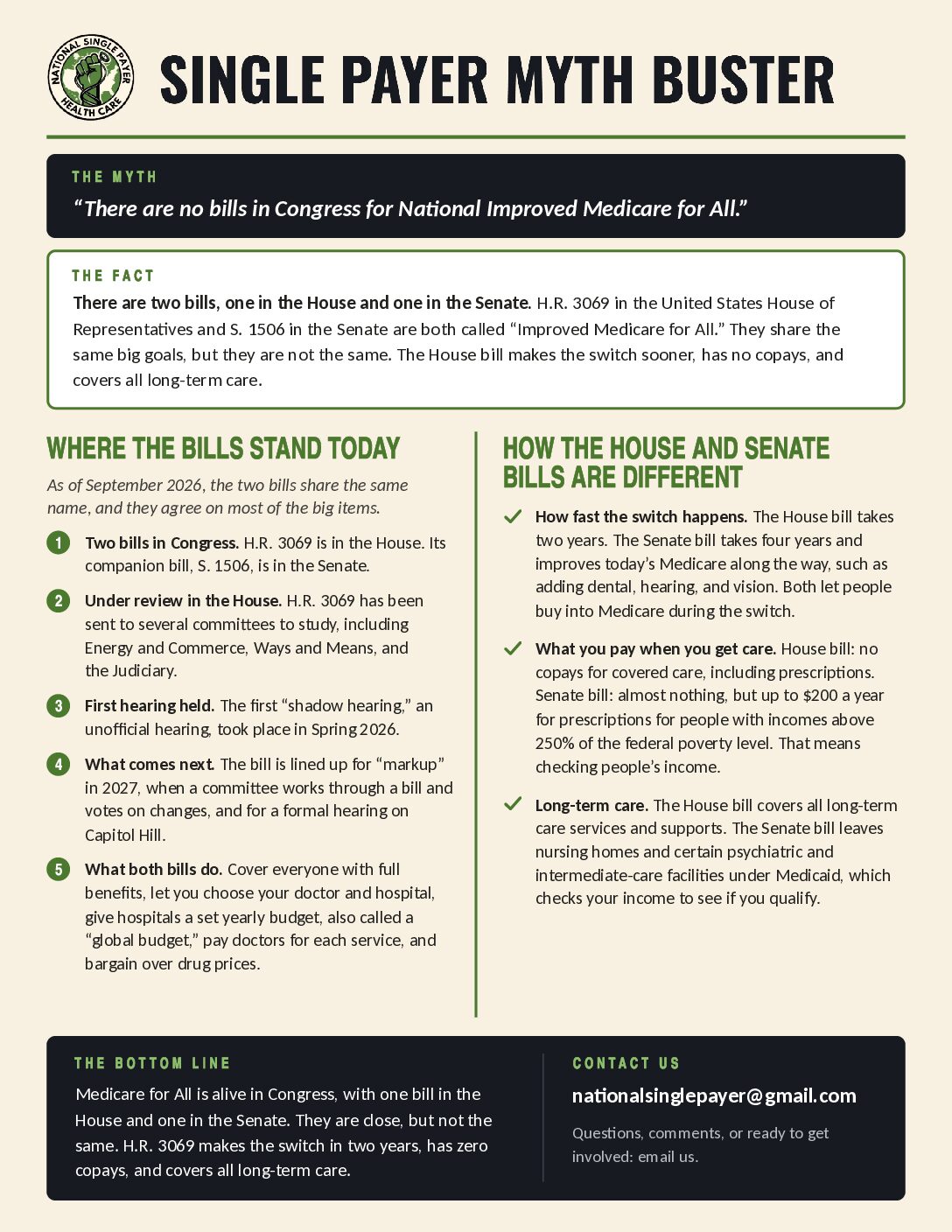
“There are no bills in Congress for National Improved Medicare for All.”
There are two bills, one in the House and one in the Senate. H.R. 3069 in the United States House of Representatives and S. 1506 in the Senate are both called “Improved Medicare for All. ” They share the same big goals, but they are not the same. The House bill makes the switch sooner, has no copays, and covers all long-term care.
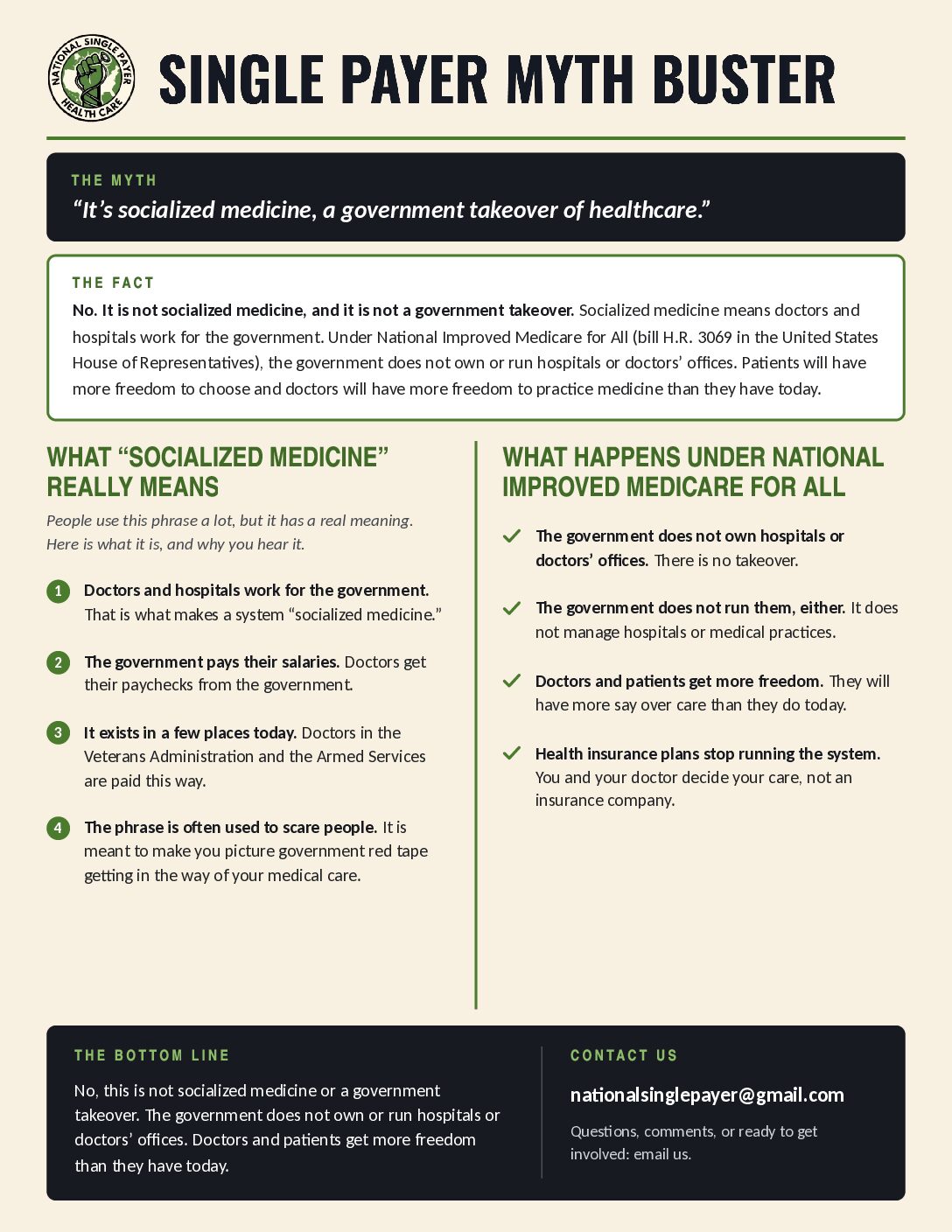
“It’s socialized medicine, a government takeover of healthcare.”
No. It is not socialized medicine, and it is not a government takeover. Socialized medicine means doctors and hospitals work for the government. Under National Improved Medicare for All (bill H.R. 3069 in the United States House of Representatives), the government does not own or run hospitals or doctors’ offices. Patients will have more freedom to choose and doctors will have more freedom to practice medicine than they have today.
“I will lose the freedom to see my preferred provider.”
Today, your insurance company picks your doctors, not you. Private plans only pay for the doctors and hospitals on their approved list, called a “network.” Go outside that list and you pay more, or you pay it all. National Improved Medicare for All (bill H.R. 3069 in the United States House of Representatives) puts almost every licensed doctor and hospital in the country into one plan, so you choose who cares for you.
“Healthcare automatically becomes a constitutional right in the U.S. ”
No. Passing the bill does not automatically make healthcare a constitutional right. National Improved Medicare for All (bill H.R. 3069 in the United States House of Representatives) protects people from the costs of healthcare. It does not directly say that healthcare is a human right. But it does bring the United States closer to its duty to protect everyone’s right to health.
“National Improved Medicare for All will have as many gaps as Medicare.”
It covers all the care you need without having to pay when you get the care. National Improved Medicare for All (bill H.R. 3069 in the United States House of Representatives) covers all care that is medically necessary or appropriate. It bans premiums, deductibles, and copays for covered care. Covered care is reviewed every year. With Congress keeping watch, new medical advances can be added, but by law nothing can be taken away.
“Tweaking the ACA will get us to National Improved Medicare for All. ”
Small fixes to the Affordable Care Act (ACA) will not get us there. The ACA leaves private insurance companies in charge of our healthcare, and nothing in it limits how much they can raise their prices. More government help lowers what people pay each month, but it also sends more money to those companies. National Improved Medicare for All (bill H.R. 3069 in the United States House of Representatives) is a fix that works and lasts.
“We will lose even more primary care and family medicine doctors.”
National Improved Medicare for All will bring primary care doctors back, not drive them away. Today’s system buries family doctors in insurance paperwork, pays less for their kind of care, and pushes them to burn out or sell their practices to corporations. The bill (H.R. 3069 in the United States House of Representatives) removes those burdens, so more medical students choose primary care and more doctors stay.
“National Improved Medicare for All will not cover preventive care.”
Preventive care is fully covered. Alternative care has a path to coverage written into the bill. National Improved Medicare for All (bill H.R. 3069 in the United States House of Representatives) lists primary and preventive care among its core benefits. It also has the nation’s top health official work with experts to identify which complementary and integrative practices, often called “alternative” care, should be included.
”National Improved Medicare for All will not cover alternative care. ”
Preventive care is fully covered. Alternative care has a path to coverage written into the bill. National Improved Medicare for All (bill H.R. 3069 in the United States House of Representatives) lists primary and preventive care among its core benefits. It also has the nation’s top health official work with experts to identify which complementary and integrative practices, often called “alternative” care, should be included.
“The rationing of medical care and overutilization will increase. Wait times will increase."
Care is already rationed today, by your wallet.Insurers decide who gets care based on who can pay, what a plan covers, and how much paperwork stands in the way. National Improved Medicare for All (bill H.R. 3069 in the United States House of Representatives) ends rationing by ability to pay and moves the money now lost to paperwork and profit into more doctors, nurses, and clinics.
“We can start by lowering the eligibility age of Medicare to 55 and eventually get to National Improved Medicare for All.”
Lowering the Medicare age to 55 is a small step that leaves many people out. It is not a better fix than National Improved Medicare for All (bill H.R. 3069 in the United States House of Representatives). That bill covers every resident from birth to end of life. A plan that helps only some of us also weakens the unity we need to win healthcare for all of us.
“Commercial Health Insurance Companies Don’t Ration Medical Care.”
They ration care every day. Commercial health insurance companies limit your care by putting costs and company approvals in your way. This is often called market-based rationing, and it is built on a “denial-of-care” business model. These companies delay and deny medical care on purpose, because it makes more money for the company and its investors. National Improved Medicare for All (bill H.R. 3069 in the United States House of Representatives) ends this business model.
“The health insurance business model is not denial-of-care.”
Care is already rationed today, by your wallet. Insurers decide who gets care based on who can pay, what a plan covers, and how much paperwork stands in the way. National Improved Medicare for All (bill H.R. 3069 in the United States House of Representatives) ends rationing by ability to pay and moves the money now lost to paperwork and profit into more doctors, nurses, and clinics.
“Healthcare will be rationed and wait times will go up.”
Care is already rationed today, by your wallet. Insurers decide who gets care based on who can pay, what a plan covers, and how much paperwork stands in the way. National Improved Medicare for All (bill H.R. 3069 in the United States House of Representatives) ends rationing by ability to pay and moves the money now lost to paperwork and profit into more doctors, nurses, and clinics.
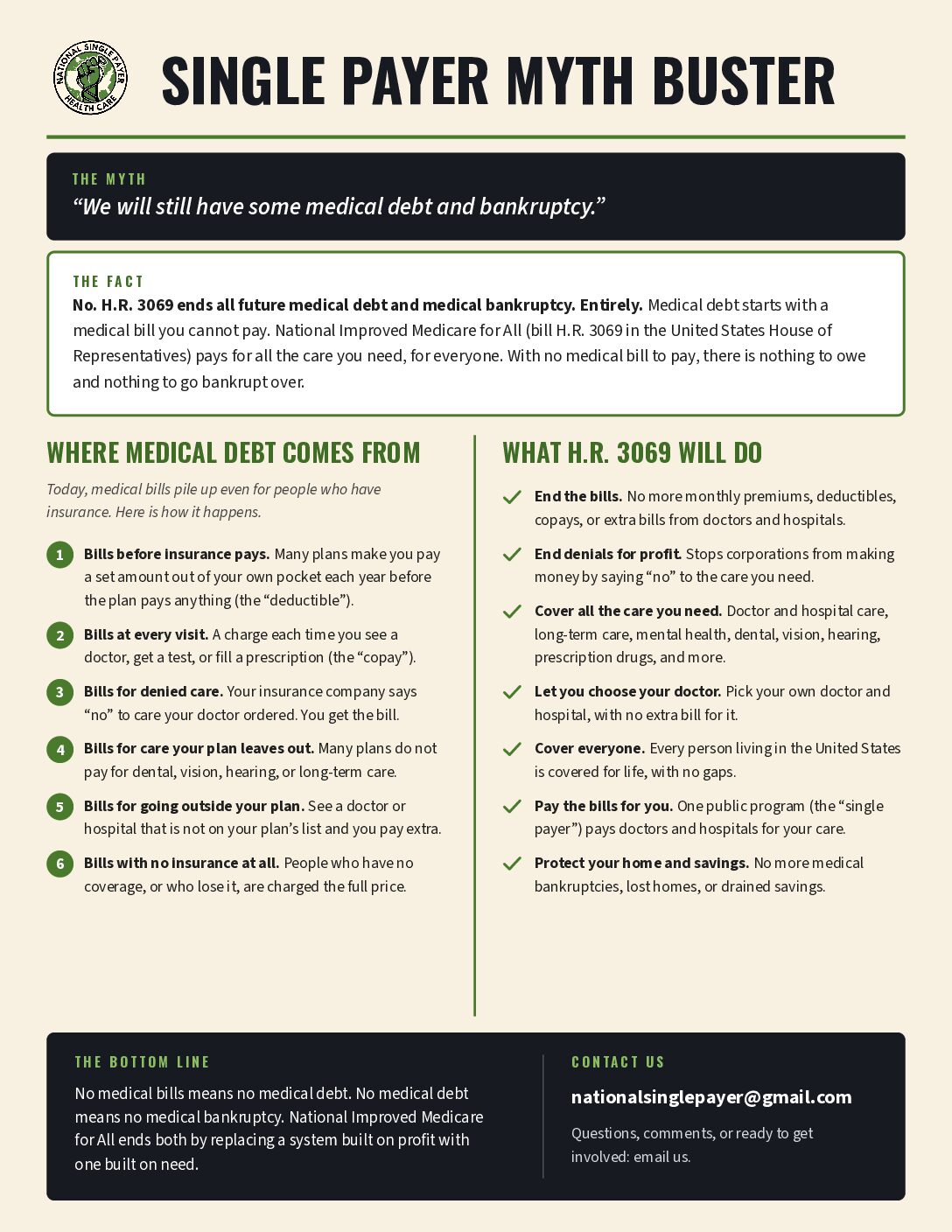
“We will still have some medical debt and bankruptcy.”
No. H.R. 3069 ends all future medical debt and medical bankruptcy. Entirely. Medical debt starts with a medical bill you cannot pay. National Improved Medicare for All (bill H.R. 3069 in the United States House of Representatives) pays for all the care you need, for everyone. With no medical bill to pay, there is nothing to owe and nothing to go bankrupt over.
“People should be able to buy commercial health insurance if they can afford it.”
People can still pay for private care, but a separate system for the wealthy hurts everyone else. National Improved Medicare for All (bill H.R. 3069 in the United States House of Representatives) lets people pay out of their own pocket for private care or commercial insurance. But insurance companies will be banned from selling plans that cover the same care as the national plan. That keeps rich and poor in one strong system.
“National Improved Medicare for All is Financed by Raising my Taxes.”
The bill does not set any taxes today. Paid for fairly, it would save most people money. As written today, National Improved Medicare for All (bill H.R. 3069 in the United States House of Representatives) does not yet say how the program will be paid for. The best answer is fair taxes: people with lower incomes pay less, and people with higher incomes pay more. Those taxes would replace the premiums, deductibles, and copays you pay today.
“My taxes will go up.”
Taxes will go up, but most people will pay less for healthcare overall. National Improved Medicare for All (bill H.R. 3069 in the United States House of Representatives) ends premiums, deductibles, copays, and medical bills. Taxes take their place. Because the plan cuts waste and paperwork, the vast majority of people will pay less in new taxes than they pay for healthcare today.
“People should be able to jump the queue if they can afford it.”
When the wealthy can pay to cut the line, everyone else waits longer and gets worse care. Under National Improved Medicare for All (bill H.R. 3069 in the United States House of Representatives), everyone gets all medically needed care from one public program. People can still pay on their own for private care if they choose. But insurance companies cannot sell plans for care the public program already covers. That keeps one strong system for all of us.
“National Improved Medicare for All Will Increase the Federal Deficit and Bankrupt the U.S.”
No. National Improved Medicare for All will save money, not add to the deficit. The bill (H.R. 3069 in the United States House of Representatives) cuts wasteful paperwork and uses proven ways to keep prices under control. The money saved pays to cover everyone in the United States with full benefits and nothing to pay when they get care. The U.S. would spend less than it does today, not more.
“The government will make medical decisions.”
You and your doctor will make your medical decisions. Today, insurance companies do. Right now, private health insurance companies decide your choices, your doctors and hospitals, and even how your health turns out. Under National Improved Medicare for All (bill H.R. 3069 in the United States House of Representatives), medical decisions are left to the patient and the doctor, as they should be.
“National Improved Medicare for All will stifle innovation.”
Single payer frees innovation. Public money already pays for much of the medical research. The United States government funds much of today’s medical research through the National Institutes of Health (NIH). Drug companies often use that public research to make the drugs they sell, and they spend more on marketing and administration than on research. National Improved Medicare for All (bill H.R. 3069 in the United States House of Representatives) ends the marketing and frees doctors and scientists to focus on new discoveries.
“National Improved Medicare for All will add more federal bureaucracy.”
It will cut bureaucracy, not add to it. The United States already has the most bureaucratic healthcare system in the world. Bureaucracy means red tape: the paperwork, rules, and approvals that stand between you and your care. Today that red tape comes from thousands of private insurance plans. National Improved Medicare for All (bill H.R. 3069 in the United States House of Representatives) puts one public program in their place.
“National Improved Medicare for All will increase costs rather than reduce costs.”
The new costs will be covered by savings. We have heard this warning before, and it was wrong. In 1965, when Medicare began, the Wall Street Journal ran a headline about the possible collapse of the healthcare system. It never happened. National Improved Medicare for All (bill H.R. 3069 in the United States House of Representatives) pays for care that people skip today, and savings in other places make up for it.
“National Improved Medicare for All will increase the price of my medications.”
No. You will pay nothing for your medications at the pharmacy, and drug prices will come down. National Improved Medicare for All (bill H.R. 3069 in the United States House of Representatives) covers all the prescription drugs you need. One public program buys medications for the whole country, so it can bargain with drug companies for lower prices.
“PBMs (pharmacy benefit managers) help us control costs of drugs.”
PBMs are middlemen, and they make drugs cost more, not less. A PBM stands between your insurance company and your pharmacy and keeps a hidden cut of what your medicine costs. National Improved Medicare for All (bill H.R. 3069 in the United States House of Representatives) removes these middlemen. The country bargains directly with drug makers, and you pay nothing at the pharmacy counter.
“National Improved Medicare for All will increase fraud & white-collar crime.”
The opposite is true. National Improved Medicare for All takes away the reasons to cheat. Today’s system of many competing insurance companies rewards billing tricks, unneeded care, and denied care. H.R. 3069 (the National Improved Medicare for All bill in the United States House of Representatives) replaces it with one public program. That changes who gets paid, and for what.
“Medical professional salaries will decrease.”
Paperwork and waste get cut. Pay for medical professionals is set up to be fair. National Improved Medicare for All (bill H.R. 3069 in the United States House of Representatives) has one public program pay for care. That greatly reduces the billing and insurance paperwork medical offices handle today, which frees up money and time. Doctors and other medical professionals get back to the work they trained for: caring for patients.
“People who like their private health insurance will be able to keep it.”
False. Under H.R. 3069, the commercial health insurance people have today goes away. The bill makes it against the law for a private health insurer or an employer to sell or provide coverage for the same care the national public plan already covers. The public plan covers almost all medically necessary care, so almost every commercial plan in use today will end.
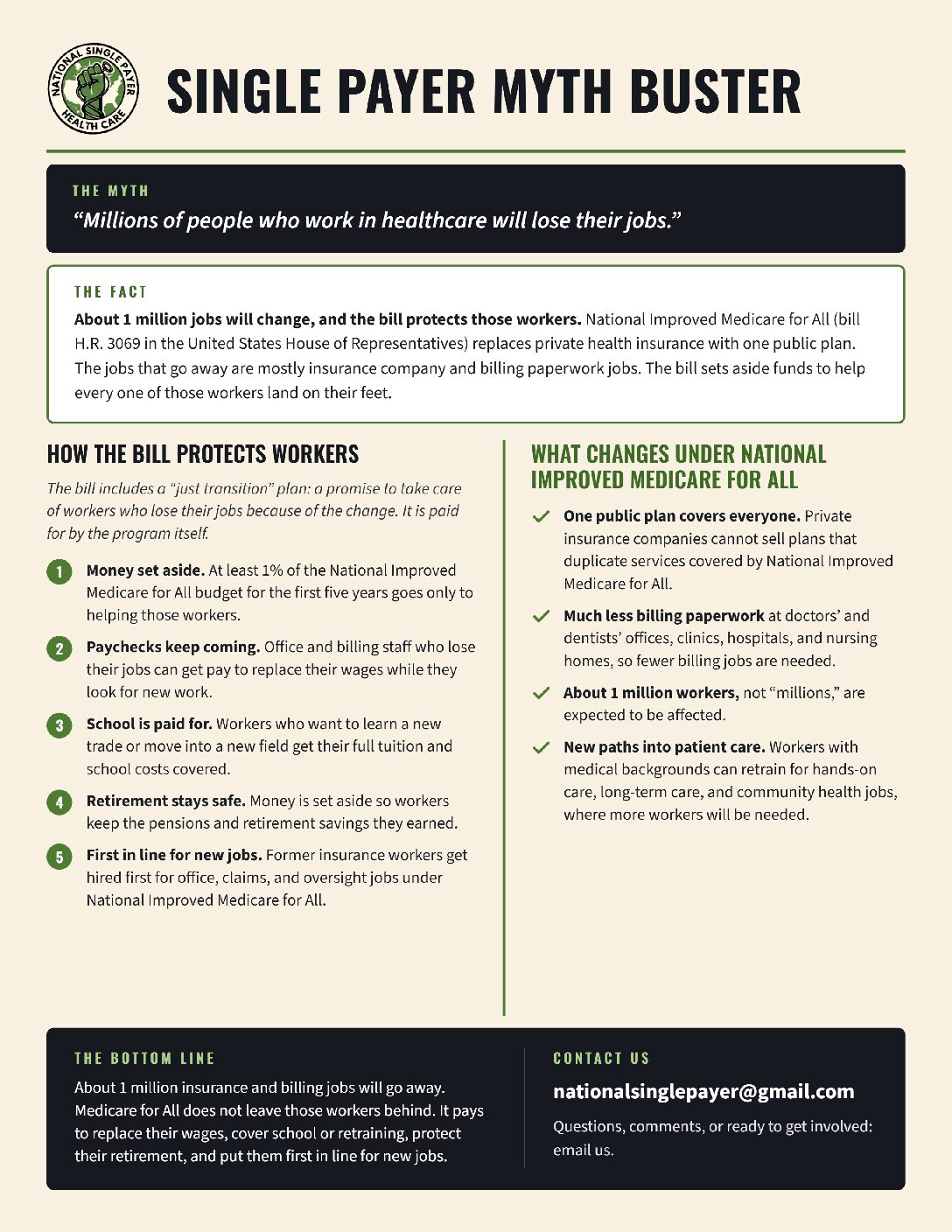
“Millions of people who work in healthcare will lose their jobs.”
About 1 million jobs will change, and the bill protects those workers. National Improved Medicare for All (bill H.R. 3069 in the United States House of Representatives) replaces private health insurance with one public plan. The jobs that go away are mostly insurance company and billing paperwork jobs. The bill sets aside funds to help every one of those workers land on their feet.
“National Improved Medicare for All is not for kids or parents.”
Every newborn, child, teen, and parent is covered. National Improved Medicare for All (bill H.R. 3069 in the United States House of Representatives) signs up every child at birth and covers the care a growing child needs, with no deductibles and no copays. Parents are covered too, and no parent has to choose between the household budget and medical treatment for a child.
“National Improved Medicare for All will be worse for seniors.”
National Improved Medicare for All will be better for seniors. It covers more, with nothing to pay for care. More people in the United States are growing older, and healthcare costs keep rising. National Improved Medicare for All (bill H.R. 3069 in the United States House of Representatives) takes on both. It changes what is covered, and it gives the federal government the power to bargain for lower prices.
“ERISA prevents implementation of National Improved Medicare for All.”
ERISA does not stand in the way. H.R. 3069 changes ERISA so the national program can go forward. ERISA is a federal law that limits what a state can require of employers. It does not stop Congress from creating a national program. National Improved Medicare for All (bill H.R. 3069 in the United States House of Representatives) is a national law, and it updates ERISA to fit the new program.
“National Improved Medicare for All will be too big to manage.”
Our country already runs big national programs, and they work. Medicare, Social Security, the National Parks, and the National Highway System serve people all over the country. National Improved Medicare for All (bill H.R. 3069 in the United States House of Representatives) is built to be managed, with clear rules for doctors and hospitals and strong protections against fraud and abuse.
“Health Savings Accounts can pay my medical expenses.”
A Health Savings Account can run out fast and leave you with large medical bills. A Health Savings Account (HSA) is a personal account you use to pay your medical bills. If it runs out, you pay out of your own pocket until you reach your deductible, the amount you must pay before private insurance starts to pay. National Improved Medicare for All (bill H.R. 3069 in the United States House of Representatives) covers everyone in one program and keeps healthcare affordable for all.
“I should not have to pay for the healthcare of others.”
Everyone’s health is safer when everyone is healthy. Many of us learned this for the first time during the COVID pandemic. Sick coworkers and neighbors put our own health at risk. Giving everyone access to healthcare makes sense for public health, and it is the right thing to do. National Improved Medicare for All (bill H.R. 3069 in the United States House of Representatives) is true healthcare for all.
“Let’s do this in small steps, that’s better for everyone.”
Small steps are detours. They lead us away from healthcare for everyone. The goal is National Improved Medicare for All: healthcare that is paid for with public money and free from profit. It is a “single payer” plan, which means the federal government is the one payer for everyone’s care. That is the best way to pay for healthcare so that everyone is covered and costs stay under control.
“National Improved Single Payer will not help hospitals.”
National Improved Single Payer gives hospitals steady funding in rural areas, suburbs, and cities nationwide. Today, hospitals are paid one bill at a time by hundreds of insurance plans, and many bills are never paid at all. National Improved Medicare for All, the single payer bill (H.R. 3069 in the United States House of Representatives), replaces that with dependable funding, so hospitals can plan ahead and focus on patients.
“We should not cover undocumented immigrants or people who live here temporarily.”
Covering everyone who lives here keeps all of us healthier and costs less. National Improved Medicare for All (bill H.R. 3069 in the United States House of Representatives) covers every resident of the United States, including undocumented people. Coverage is based on where you live, not on citizenship or immigration status. When everyone can see a doctor, fewer people end up in the emergency room and fewer bills go unpaid.
“National Medicare for All is un-American.”
Guaranteed healthcare protects freedom, rewards hard work, and lets businesses compete fairly. Americans have been told for decades that free-market competition makes healthcare better. But healthcare is not like other markets. National Improved Medicare for All (bill H.R. 3069 in the United States House of Representatives) is paid for publicly but delivered privately. Doctors and hospitals stay private, and you choose where to get your care.
Sign Up For Our Newsletter
Stay informed about NSP events, working group meetings, webinars and primers by signing up for our monthly newsletter here.
Fill out this form to find out more.