Activist Toolkit
Below you will find resources to help you:
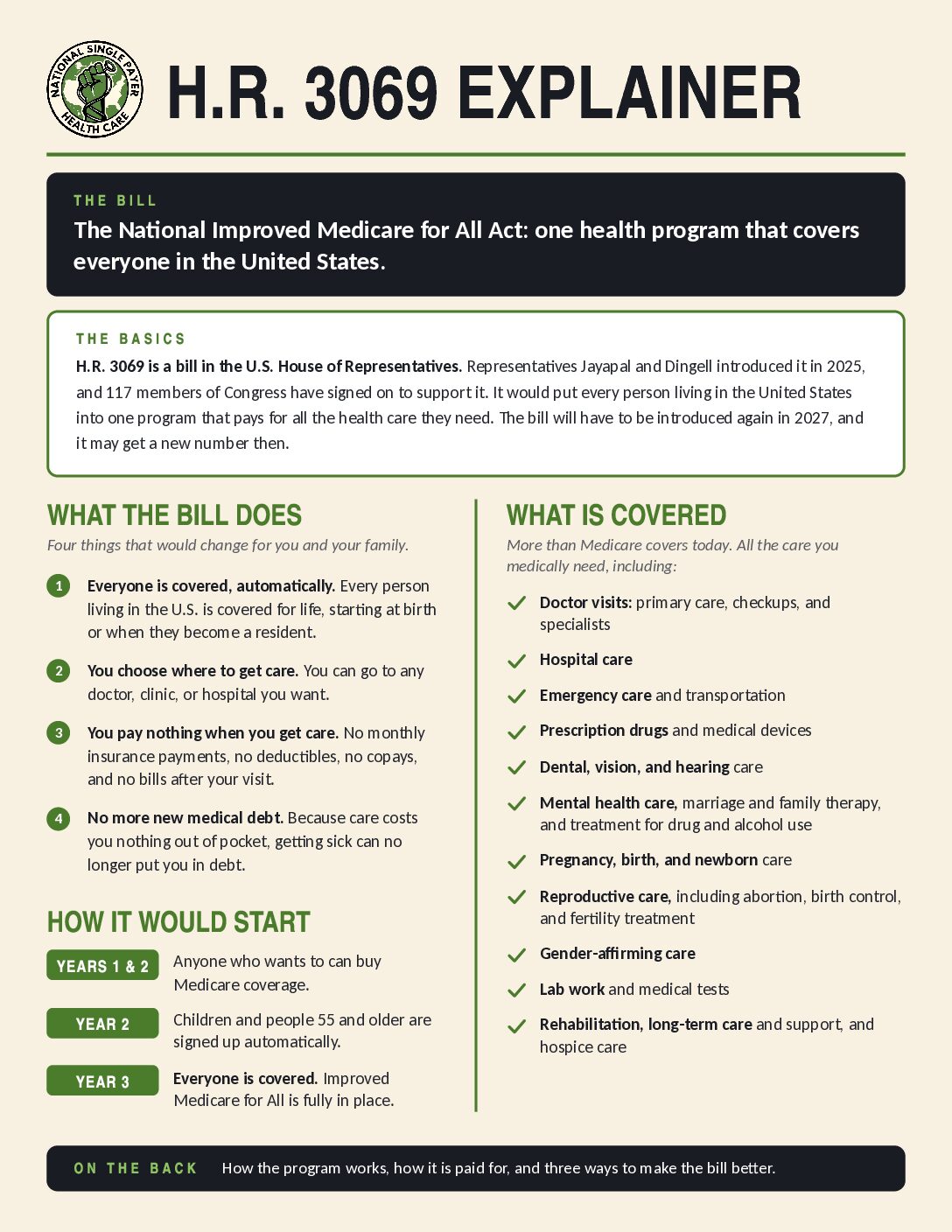
Describe the details of H.R. 3069.
Learn the facts necessary to bust the most commonly used single payer myths and recognize the “off-ramps” that move us away from our goal.
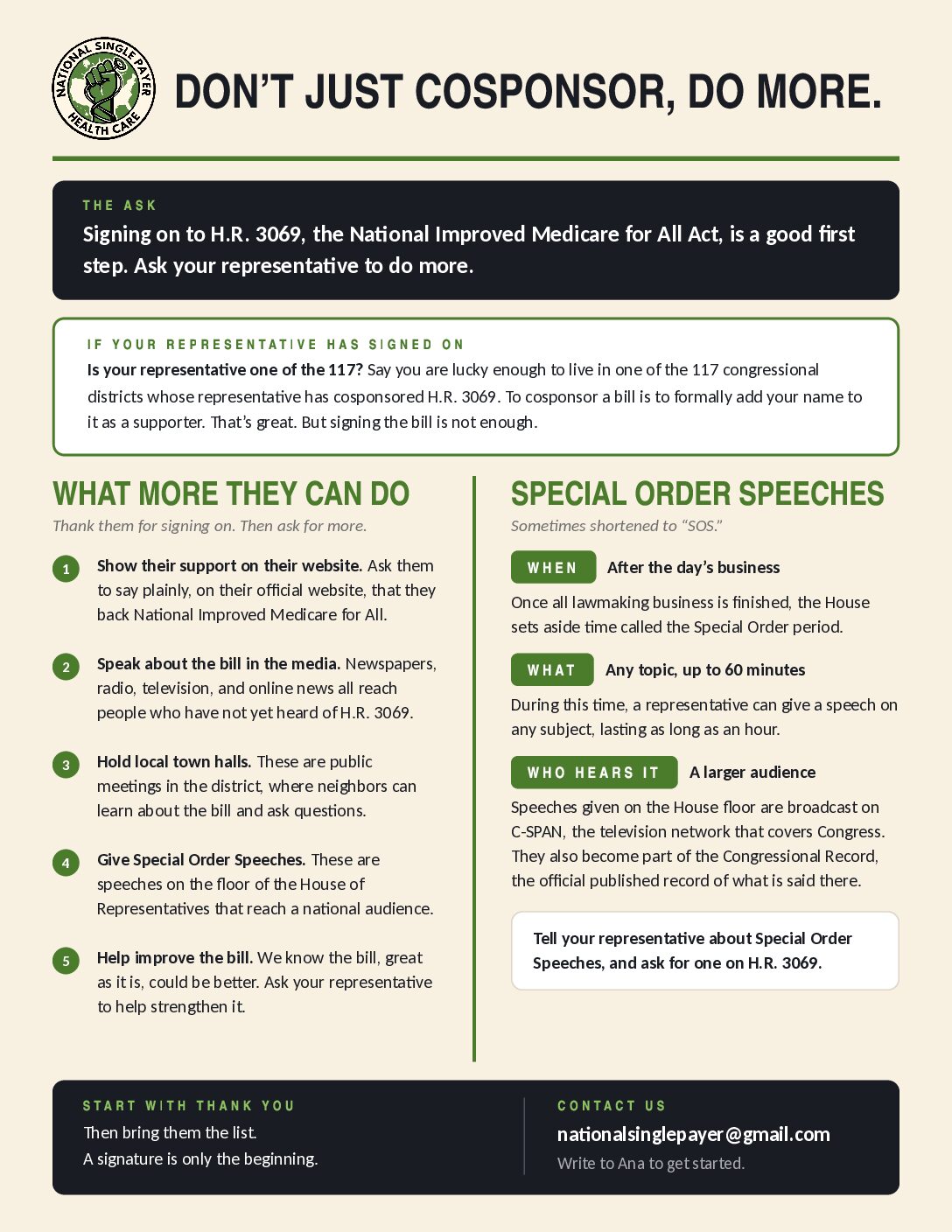
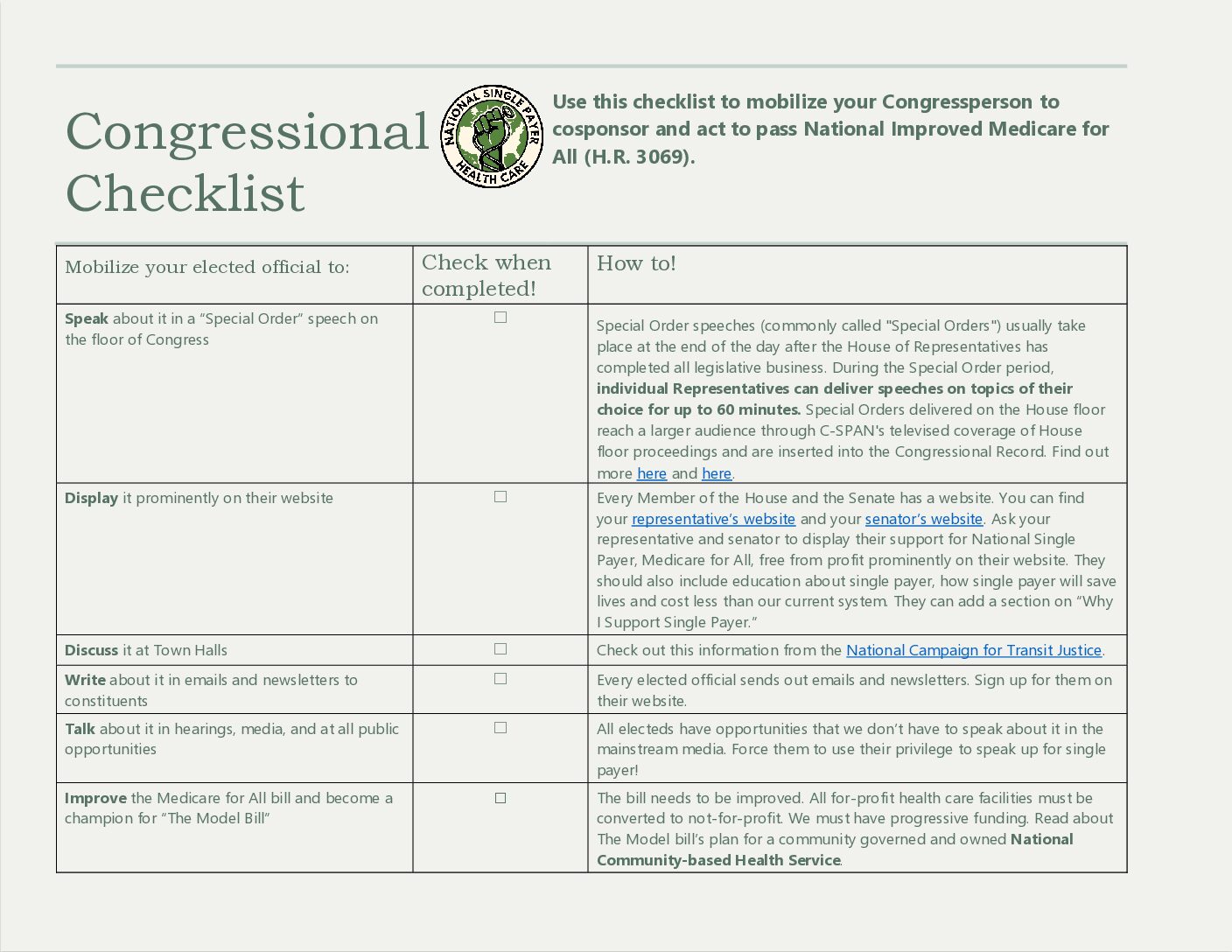
Have the tools to educate your candidates, senators and reps to do much more than just cosponsor H.R. 3069.
Create local action to pass H.R. 3069 organizing “District-by-District.”
H.R. 3069 Explainer
Don't Just Co-Sponsor Do More!
Organizing
District-By-District



National Improved Medicare for All (H.R. 3069)
Detours from Single Payer
Deep Dive
1) Lowering the Age of Medicare.
On October 22 (less than two weeks before the midterm elections), Representative Jayapal and others introduced H.R. 10875, the Improving Medicare Coverage Act, legislation that lowers the Medicare age to 50, while leaving private insurance in control of health care.
On November 5 (2 days after the midterms), Senator Sanders, the most stalwart supporter of Medicare for All, released a statement where he listed many of the important agenda items that a Democratic majority in Congress must address, including Improved Medicare for All. However, he added, “As an immediate first step Democrats must lower the Medicare eligibility age from 65 down to 55, expand Medicare to cover dental, vision and hearing, and guarantee universal health care coverage for every child from birth to age 19.”
On November 10 (one week after the midterms), fellow Democratic Senator Tammy Baldwin led colleagues in introducing a bill to lower the age of Medicare to 50, touting it would lower health care costs.
Proposals to “get us to Medicare for All” without actually getting us there are coming fast and furious.
The foremost goal of any national single payer organization is to build a movement that can successfully enact Improved Medicare for All, free from profit, in the shortest time possible. While lowering the Medicare age to 50, or to 55, or adding children, sounds appealing, and a great first step towards Medicare for All, the policy crumbles when it is examined closely and dispassionately.
- R. 10875 places the financing burden for Medicare for those ages 50 to 64 on the federal government, relieving employers of those costs. The cost of covering those estimated 62 million new Medicare enrollees is unknown, but we can predict it will be massive because the savings of Improved Medicare for All are missing.
Unlike in H.R. 3069, the Improved Medicare for All Act in the House, and S 1506 in the Senate, there are zero cost savings in H. R. 10875, there are no benefit improvements, and there will be no relief from the costs of supplementary care and drug plans.
These “immediate first steps” do not guarantee funding for the 700 rural hospitals at risk of closing and other facilities serving our communities.
What else do these urgent missteps from Congressional leaders fail to do?
- Prevent Medicare Advantage plans from scooping up over 50% of new enrollees, upcoding, denying care, and increasing their profits as these companies overcharge Medicare to the tune of $76 billion annually. We know well how insurance companies offering Medicare Advantage plans cherry pick the least expensive beneficiaries. Newly enrolled younger beneficiaries will have a target on their back.
- Eliminate Part B and Part D premiums, or a MediGap supplemental plan for those who choose to stay in traditional Medicare or protect these beneficiaries from the alternative payment models run by the Center for Medicare and Medicaid Innovation.
- Significantly lower premiums for those left behind or eliminate health insurance companies and their profits. By removing the costlier beneficiaries and shifting these to a public program, it will likely increase industry profits.
- Control the price of prescription drugs.
- Guarantee comprehensive medical benefits including prescription drugs and long-term care.
- Eliminate medical debt.
- Guarantee coverage to the dependents of individuals 50-64 who choose to enroll in Medicare (spouses, children under 26).
Mysteriously, the legislation will sunset after five years, leaving open the possibility of more disastrous consequences, reminiscent of the partisan fight in December 2025, when the enhanced subsidies in the Exchanges were allowed to expire.
The savings of H.R. 3069, Improved Medicare for All, come from the removal of the insurance industry with its high profits and administrative costs, redirecting the savings to be used to improve benefits and to expand those benefits to include everyone. Without those savings, adding millions to Medicare will massively increase federal funding, reinforcing the false conclusion that Medicare for All is too expensive. That will hurt rather than facilitate passing Improved Medicare for All.
Our next step should not enrich our opposition further. Our next step should not be another detour away from Medicare for All. How many times must we fall off the cliff before we force our elected officials to pass legislation necessary to guarantee every resident comprehensive medical benefits from cradle to end of life?
In the recent midterm elections, the people gave Congress a mandate to improve H.R. 3069 and then pass legislation.
Experienced negotiators know how to put everything on the table upfront. The people have spoken. Congress must not squander our trust by asking for a half loaf and settling for crumbs.
2) The Public Option.
The public option, the most popular detour, proposes to create a Medicare-like plan that would exist alongside private plans. People could purchase this public option rather than paying premiums for a private plan through their employer or on the Exchange.
The public option allows candidates to campaign on universal health care without taking on the insurance industry because the public option maintains private insurance, their administrative waste and profits, intact. This allows candidates to avoid confronting the corporate control of health care and continue to accept donations from the industry.
Proponents of the public option assert that because Medicare is more efficient, spending only 2% in administration rather than the 15 or 20% that private plans spend, people would choose the public Medicare-like plan. Private plans would gradually wither away, paving the way to single payer.
Proponents also believe that given the choice, individuals would choose the public option over private health insurance plans.
We have a real-life experiment between traditional Medicare (i.e., the public option) and for-profit Medicare Advantage (private insurance plans), that shows the fallacy in the argument. There is no such thing as a level playing field when it comes to these giant corporations. There could never be enough regulators to keep insurance companies from padding their bottom line.
Private insurance companies game the system, cherry pick the healthiest patients and lemon drop the sick ones, upcode, create narrow networks, demand prior authorization and deny and delay claims. Medicare Advantage now has more than half of the senior population, not because it is better, but because it is great at all the tricks to profit at the expense of the public.
The public option would become the home of the sickest, most expensive patients, crashing the plan as the insurance companies stash the cash from the healthiest patients.
The public option fails to reap administrative savings or control costs necessary to provide comprehensive universal coverage. The public option is a dead end.
For an excellent analysis of how the public option is a detour to nowhere, please read Anita Kestin’s article Opinion | Fools Gold: The Mirage of the Public Option | Common Dreams
3) Tweaking the Affordable Care Act.
Many who reject single payer as impossible assert that we can arrive at universal coverage and lower costs by tweaking the Affordable Care Act, also known as Obamacare, passed by Congress in 2010.
They propose numerous patches that they claim will close the gaps, or bring down the costs, or end the denials, or patrol the prior authorization, or broaden the networks, or expand the navigators, or hold insurance companies accountable. The list is endless.
The Affordable Care Act can’t be patched up into covering us all while controlling costs. Its essence is to funnel all the funds through the private insurers.
A private insurance company, by law, must act to enhance profit for shareholders. That means that the purpose of private health insurance, a return for shareholders, directly contradicts the public interest in a healthy nation providing care to all.
We have the highest costs and the worst outcomes of any wealthy nation. The Commonwealth Fund, a foundation dedicated to affordable, quality healthcare for all, calls it a failing system.
We must replace this healthcare system which fails so many with a national single payer system, free from profit, and proven worldwide to provide universal care at much less cost.
4) Breaking Up Big Medicine.
“Breaking Up Big Medicine” is a detour paved by a set of anti-trust bills proposed in the Senate and the House that would separate private insurers and other middlemen, such as Pharmacy Benefit Managers (also known as PBMs) and pharmacy wholesalers, from healthcare providers.
The separation could prevent a single conglomerate from being on both sides of a transaction, avoiding the conflict of interest that exists when the insurer owns the provider and can overpay the provider (that they own) to avoid profit caps imposed by the federal government. (For an explanation of how Pharmacy Benefit Managers work, see Deep Dive on the Myth “PBMs will help us control costs of drugs.”)
These reforms are appealing. We are outraged by the rising cost of health insurance premiums, prescription drugs, and the excessive control of healthcare by insurance monopolies. But these anti-trust bills, important as they are, will require a massive regulatory effort and administrative overhead to enforce.
Even if the breakup succeeds, the same multi-payer private insurance financing of healthcare remains. Corporations still have a responsibility to their shareholders to make a profit, and the formula for profit still includes delay and denial of care. Insurance companies will still be able to cherry pick the healthiest, lowest risk individuals and drop the sickest, higher risk individuals. The profit incentives remain intact.
Nothing in these reforms creates a path to healthcare for the uninsured or underinsured, nor provides coverage for dental, vision, hearing, and long-term care. The reforms do not provide the administrative savings needed to fund comprehensive, universal healthcare. “Breaking Up Big Medicine” is a detour to nowhere.
5) State “single payer.””
The state “single payer” movement supports a detour that looks politically feasible in contrast to the fight for national single payer. Supporters claim that once key individual states adopt single payer plans, the rest of the country will follow, and national single payer will be the inevitable outcome. The devil is in the details.
States must contend with multiple federal plans already operating in their healthcare landscape, including Medicare, the VA, the Indian Health Service, the Federal Employees Health Benefit Program, the Exchanges (“Marketplace”), and TriCare. Medicaid, a joint federal-state partnership providing health coverage to low-income individuals, will also need to be folded into the state “single payer” plan.
Because states cannot afford a universal health care system without federal funds, state legislators will need to apply for federal waivers to capture the money from the federal programs listed above that will be needed to fund the state “single payer” program. Federal waivers (if they are obtained) increase bureaucracy and jeopardize funding for Medicare for everyone else in the country. A federal waiver to access Medicare funds must be passed by the U.S. Congress first.
After passing a state “single payer” bill, the state will need to incorporate multiple existing payers and their participants instead of creating one plan for everyone.
As every state “single payer” activist knows, it takes a massive effort to pass state “single-payer” legislation, and then years of work to implement the plan. In the end, state “single-payer” will not achieve the administrative savings needed to fund coverage for everyone because there will be multiple payers, it will not allow rapid enrollment due to excess bureaucracy created by waivers.
There are many more barriers to enacting a state “single payer” bill than there would be to enact national Improved Medicare for All legislation. States must balance their budgets, the federal government does not.
We are grateful to the state activists who have educated the public about single payer for 30 years, but the efforts to fully implement single payer in one state dilute the focus on a national plan. We need everyone working together on one national Improved Medicare for All plan.
For an excellent, comprehensive analysis of the history of state “single-payer,” read Anne Scheetz review in Solidarity Now: (3) State “single-payer” cannot be a route to national single-payer: a review.
~ ~ ~
QUESTIONS? COMMENTS? EVENT? VIRTUAL MEETING?
Contact us at NationalSinglePayer@Gmail.com
National Improved Medicare for All (H.R. 3069)
Single Payer Myths & Myth Busters
Deep Dive
1) “NOW IS NOT THE TIME TO PASS NATIONAL IMPROVED MEDICARE FOR ALL. WE HAVE OTHER PROBLEMS.”
Why now?
Access to lifelong healthcare is the foundational cornerstone of equity, economic dignity and equality. Every so often, conditions in our healthcare system become so dire that an opportunity opens for us to change the system from one based on profit to one based on need.
We are living in such a moment.
Only National Improved Medicare for All will guarantee every resident of the United States access to medical care without barriers, gaps or denial-of-care.
Why the Urgency?
National Improved Medicare for All (H.R. 3069) establishes a National Health Program to provide comprehensive protection against the costs of healthcare and health-related services. The bill creates a financing system, in which a single public agency (the “single payer”) collects funds and pays for healthcare services.
The delivery of care remains largely private. Under National Improved Medicare for All, every resident of the United States is covered for all medically necessary services, including doctor, hospital, preventive, long-term care, mental health, reproductive healthcare, dental, vision, hearing, prescription drugs and medical supplies. Patients regain free choice of doctor and hospital, and doctors regain autonomy over patient care.
H.R. 3069 will:
- Eliminate all cost-sharing, monthly premiums, deductibles, coinsurance, copayments and balance billing
- Eliminate medical bankruptcies
- Prevent foreclosures and asset depletion
- End the corporate medicine “denial-of-care” business model
- Stop preventable harm and death caused by delays and denials
- Mitigate physical and psychological harm
- Reduce moral injury among medical professions
- Leverage business owners financially
- Improve the health of individuals and improve public health across communities nationwide
2) “THERE ARE CURRENTLY NO SINGLE PAYER NATIONAL IMPROVED MEDICARE FOR ALL BILLS IN CONGRESS.”
A shadow hearing was held in July 2026, and the bill is now poised for markup in 2027 and a formal hearing on Capitol Hill.
3) “NATIONAL IMPROVED MEDICARE FOR ALL IS SOCIALIZED MEDICINE AND A GOVERNMENT TAKEOVER.”
No. Socialized medicine is a system in which doctors and hospitals work for and draw salaries from the government. The H.R. 3069 bill is not socialized medicine.
Under H.R. 3069, healthcare providers and hospitals remain private or non-profit entities rather than becoming government operations. The “socialized medicine” misinformation is promoted by the commercial health insurance lobby. It is false.
Under the HR 3069 bill, the federal government acts as the single payer paying for the care, while patients have the freedom to choose their doctors and hospitals without network restrictions or the denial-of-care commercial health insurance companies impose on all Americans.
Unlike HR 3069, the NHS in the UK is the classic model of socialized medicine. Hospitals are publicly owned, and the vast majority of doctors, nurses, and specialists are government employees. Healthcare is funded entirely through general taxation and is free at the point of service for all residents. The Cuban government is also socialized medicine. The government exercises complete control over the country’s healthcare infrastructure. There are no private clinics or hospitals, and all medical professionals are government employees.
Here in the U.S. the Veterans Health Administration is the largest integrated healthcare network and does operate as a socialized medicine system. The federal government owns and runs the VA hospitals, clinics, and long-term care facilities, and the doctors and staff are federal employees providing care to military veterans. In recent years many parts of the VA have been privatized by commercial health insurance investment banks and the quality of care for our veterans and active-duty families have decreased as a result.
But H.R. 3069 is not socialized medicine.
4) “I WILL LOSE THE FREEDOM TO CHOOSE MY PREFERRED HEALTH CARE PROVIDER.”
The Myth of Choice
Commercial health insurance plans restrict your choice to a network of doctors, therapists, clinics, hospitals, dentists and other providers who accept the commercial health insurance company’s terms and reimbursements to take care of your medical needs, that is, if they are approved.
This is problematic for many reasons, especially because commercial health insurance companies delay and deny medical care methodically for profit. Not only do Americans not have a choice of their providers currently, but their care is restricted even when they choose a provider that is “in-network.” And, after choosing a plan, they are frequently denied care while paying premiums.
H.R. 3069 Provides True Freedom of Choice
Under H.R. 3069, National Improved Medicare for All, individuals and families will have freedom of choice and freedom of physician. Because H.R. 3069 establishes a singular, national framework encompassing all participating providers, it effectively creates a truly universal network. This permits patients to maintain continuity of care from birth to end of life with virtually any licensed physician or hospital nationwide without fearing out-of-network penalties.
Choice for Individuals and Families
Currently, individuals and families on the ACA Exchanges or Medicaid have limited choice of commercial health insurance plans as the geographic region and market dictate options for patients. Commercial health insurance companies dominate the ACA Exchanges and they restrict choice and dictate care options. Under H.R. 3069, patients will be able to choose their preferred provider.
Choice for Seniors
Currently, seniors and people with disabilities on Medicare can “choose” Medicare Advantage, which is a supplemental commercial health insurance plan to manage their health care needs. Medicare Advantage restricts choice and dictates care options. Under H.R. 3069, seniors and people with disabilities will be able to choose their preferred provider There will be no “in-network” or “out-of-network” providers because all licensed providers (practitioners, hospitals, clinics, medical facilities, etc.) will be in-network.
Choice for Business Owners & Employers
Currently, when employers decide to switch —or are forced to switch to -– to a new commercial health insurance plan, the options for their employees change, and often the network of providers changes, too, forcing employees to change doctors and hospitals. Freedom to choose a commercial health insurance network is not freedom at all. Under H.R. 3069, employees will be able to see their medical providers of choice from birth to death. Employers will no longer need to navigate multiple commercial health insurance plans, healthcare benefits or the qualitative and quantitative costs related to providing commercial health insurance for their employees.
True Choice
- If you are a woman who would prefer to see a female gynecologist, you will be able to see them under H.R. 3069.
- If you are a Black patient who only wants Black providers, you will be able to choose that provider.
- If your doctor speaks your language and you don’t want to change, you will be able to choose her.
- If you are a person living with disabilities and want to see a physician with expertise that gives you peace of mind, you have that choice.
- If you have a doctor who has known your family for generations, that will be your choice, not your employer’s, not your state’s and not your commercial health insurance company’s choice.
- H.R. 3069 provides true choice.
5) “AFTER H.R. 3069 IS PASSED, HEALTHCARE WILL AUTOMATICALLY BECOME A CONSTITUTIONAL RIGHT IN THE U.S.”
People often ask if National Improved Medicare for All will make healthcare a “human right” in the U.S. No, it does not.
H.R. 3069 only refers to providing comprehensive protection against the costs of healthcare and health-related services, and does not refer to the Constitutional obligation to promote the general welfare.
H.R. 3069 would force the U.S., a signatory to several treaties, including the Universal Declaration of Human Rights, to assume a higher level of obligation to all residents and bring the U.S. closer to its duty to respect, protect, and fulfill the human right to health. However, H.R. 3069 does not explicitly make healthcare a human right.
6) “NATIONAL IMPROVED MEDICARE WILL CREATE GAPS IN MEDICAL COVERAGE.”
National Improved Medicare for All covers all medically necessary or appropriate care to promote health through prevention and to diagnose, maintain, treat, or rehabilitate an individual’s health. The bill explicitly prohibits cost-sharing, meaning there are no deductibles, copays, or premiums for any covered benefits. In addition, it requires the Secretary of Health and Human Services (HHS) to review the benefits package annually. With Congressional oversight, the Secretary can expand coverage to include new medical advances, but is legally barred from removing or cutting any existing benefits.
The National Improved Medicare for All bill includes:
- Hospital & Outpatient Care: Includes inpatient hospital stays, emergency services, ambulatory care, and surgery.
- Primary & Preventive Care: Standard doctor visits, routine screenings, wellness checkups, and chronic disease management.
- Prescription Drugs: All approved medications, medical devices, and biological products.
- Mental Health & Substance Abuse Treatment: Comprehensive psychiatric care, counseling, and addiction therapy.
- Dental, Vision, & Audiology: Routine dental work, oral surgery, eye exams, eyeglasses, and hearing care/hearing aids
- Sexual and Reproductive Healthcare & Maternity Care: Complete prenatal, childbirth, and postnatal services, including full coverage for contraception, abortions, and assistive reproductive technology.
- Gender-Affirming Care: Comprehensive medical treatments, surgeries, and therapies related to transition or gender affirmation.
- Long-Term Care Services & Supports: Prioritizes skilled nursing homes-and community-based services alongside institutional nursing care.
- Hospice & Palliative Care: End-of-life care and comfort management for terminal conditions.
7) “TWEAKING THE ACA WILL GET US TO NATIONAL IMPROVED MEDICARE FOR ALL EVENTUALLY.”
Some propose strengthening the Affordable Care Act (ACA) as a step towards National Improved Medicare for All.
Enhanced tax credits in the ACA Exchanges expired at the end of 2025. Bringing those back will control the cost of premiums for individuals on the ACA Exchanges but it will also further pad the profits and stock prices of commercial health insurance corporations because no cost controls are ever placed on the rise of premiums. Insurance companies keep increasing the premiums and the government keeps paying.
Since the Exchanges were created, costs for individuals have soared, but so have insurance company profits, which have increased so much, few Americans can afford the hikes. Premiums are guaranteed to increase as healthier consumers drop their ACA coverage to avoid soaring out-of-pocket costs and commercial health insurance companies continue to leave the market. The ACA Exchanges are left with an older, sicker pool of enrollees, driving premiums up further.
Even with ACA tax credits, most enrollees are still locked into high-deductible commercial health insurance plans. These plans require patients to pay thousands of dollars out-of-pocket before insurance kicks in, frequently causing low-income individuals to forgo essential medical treatments.
The ACA keeps Americans tethered to commercial health insurance denial-of-care, to rising premiums, and to exorbitant deductibles. H.R. 3069 offers an effective, permanent solution.
8) “WE WILL LOSE EVEN MORE PRIMARY CARE AND FAMILY MEDICINE PHYSICIANS.”
National Improved Medicare for All will fundamentally revitalize the primary care workforce by eliminating the systemic, administrative, and financial burdens that currently drive medical students away from primary care and push practicing physicians toward burnout or corporate consolidation.
National Improved Medicare for All will reverse the primary care shortage through four core mechanisms:
Eliminating Administrative Burden and “Moral Injury”
Most physicians currently spend hours filling out insurance paperwork, fighting prior authorizations, and justifying treatments to private insurance adjusters.
The Change: H.R. 3069 bans health insurance companies from selling insurance that duplicates any service provided under the Improved Medicare for All program, reducing to almost zero, the number of hours spent billing and contesting claims. H.R. 3069 also bans prior authorizations. It establishes a national fee schedule and a uniform national system for electronic billing.
The Result: Doctors reclaim hours of their workday previously lost to clerical billing cycles. This directly treats the “moral injury” and burnout that cause early retirement among doctors, allowing them to focus entirely on patient care rather than corporate billing networks.
Overhauling Reimbursement Models to Value Preventive Care
The current system operates heavily on a “fee-for-service” matrix that financially rewards high-volume, high-margin specialized procedures (like surgeries and advanced imaging) while undervaluing cognitive, time-intensive primary care services (like managing chronic conditions or nutritional counseling).
The Change: H.R. 3069 relies on centralized National Health Budgets/Global Budgets.
The Result: The federal government can actively tilt regional fee schedules to increase compensation for general practitioners. Making primary care financially lucrative relative to specialties incentivizes more medical school graduates to select family medicine residency programs.
Incentivizing Independent and Local Practices
Private practices are increasingly bought out by massive corporate hospital systems because independent family doctors cannot keep up with the overhead costs of managing dozens of different insurance billing networks.
The Change: A single, unified payment stream removes the multi-layer billing infrastructure.
The Result: Overhead costs for running an independent clinic plummet. General practitioners can sustainably operate local, community-focused practices without needing to merge into corporate healthcare conglomerates to survive financially.
Eradicating Financial Barriers to Comprehensive Health Services
Healthcare providers are challenged when patients skip preventative visits or cannot afford the medications prescribed to manage serious conditions like diabetes or hypertension, which subsequently leads to severe, preventable hospitalizations.
The Change: The bill eliminates all out-of-pocket costs, copays, and deductibles.
The Result: Patients are free to see their primary care physician before minor issues escalate. This shifts the focus of the medical system away from emergency rescue care and anchors it in comprehensive, lifetime preventative health management.
9) “NATIONAL IMPROVED MEDICARE FOR ALL WILL NOT COVER PREVENTIVE CARE.”
Yes. H.R. 3069 fully covers comprehensive preventive care and health maintenance services. The bill explicitly designates primary and preventive services as core benefits. This includes routine physical checkups, vaccinations, and comprehensive health screenings and well as chronic disease surveillance and universal health maintenance education.
10) “NATIONAL IMPROVED MEDICARE FOR ALL WON’T COVER COMPLEMENTARY, ALTERNATIVE, AND INTEGRATIVE CARE.”
H.R. 3069 authorizes the Secretary of HHS to identify specific complementary and integrative medical practices that are appropriate to include in the benefits package and to identify barriers and mechanisms to overcome such barriers to care.
11) “THE RATIONING OF MEDICAL CARE AND OVERUTILIZATION WILL INCREASE. WAIT TIMES WILL INCREASE.”
Currently, commercial health insurance companies ration medical care based on ability to pay and shareholder target needs. Medical care is implicitly rationed by ability to pay, commercial health insurance plan affordability, cost prohibitive prices and administrative barriers.
Under National Improved Medicare for All rationing would shift to being explicit, dictated by system capacity, provider availability, and medical necessity. National Improved Medicare for All shifts funding away from administrative waste and private profit to fund the capacity required to meet the medical needs of the entire population.
12) “WE CAN START BY LOWERING THE ELIGIBILITY AGE OF MEDICARE TO 55 AND EVENTUALLY ACHIEVE TO NATIONAL IMPROVED MEDICARE FOR ALL THROUGH INCREMENTAL CHANGES.”
Lowering the traditional Medicare eligibility age to 55 is not a “better” fix than H.R. 3069. Lowering the age threshold serves as an incremental reform that utilizes an established public infrastructure to add higher-risk, costly adults to the program but forgoing the benefits of including lower-risk, less expensive individuals into the risk pool.
H.R. 3069 acts as a transformative overhaul designed to establish complete universal coverage from birth to end of life for every resident. Lowering the Medicare eligibility age leaves out many people and dilutes the solidarity we need to fight for National Improved Medicare for All.
13) “COMMERCIAL HEALTH INSURANCE COMPANIES DON’T RATION MEDICAL CARE.”
Commercial health insurance companies limit access to medical services through financial barriers and corporate gatekeeping. This is often called market-based rationing and is based on the “Denial-of-Care” business model. Commercial health insurance companies intentionally delay and deny medical care to extract corporate and shareholder wealth.
The commercial health insurance “float” is the cash a company holds onto during the time gap between collecting premium payments from customers, denying medical care and actually paying out medical claims to healthcare providers. Insurers are highly motivated to artificially widen the gap between receiving a premium and paying a doctor.
The industry uses an arsenal of chaotic administrative barriers and lengthy review processes to slow down reimbursements while patients in need wait for medical care. On a hospital’s balance sheet, this delayed money sits as accounts receivable, but on the commercial insurer’s balance sheet, it remains part of the float while generating millions of dollars in interest before it is paid out — if ever.
The delay allows commercial health insurance companies to invest this cash — frequently into securities, bonds, real estate, private equity and other investments — and increase profits, while patients struggle and suffer.
H.R. 3069 ends this business model.
14) “THE COMMERCIAL HEALTH INSURANCE BUSINESS MODEL IS NOT DENIAL-OF-CARE.”
Here are just a few examples of the denial-of-care business practices commercial health insurance companies use to delay and deny medical care:
- “Click and close” requires medical directors to maintain rapid medical care case-review quotas. Their bonuses and performance metrics are often tied to the volume of cases closed and speedy boilerplate denials.
- Step therapy, also called “fail first” by the industry, requires patients to try cheaper, less effective treatments instead of implementing what a physician recommends. Insurers deny the doctor’s prescribed treatment until the patient officially documents that the cheaper options failed to work.
- “Procedure to diagnosis,” also known as PxDx is software that allows companies to instantly batch-reject medical claims. If the submitted procedure code matches an approved diagnosis code on the insurer’s list, the doctor is paid automatically. If the codes do not align, the claim is automatically rejected, often processing in as little as 1.2 seconds. For reference, over a period of two months in 2022, Cigna doctors employed by the company to review insurance claims denied more than 300,000 requests for payments using PxDx.
- Ghost Networks are used by health insurance companies to create a false impression of comprehensive coverage by listing doctors, therapists or clinics as “in-network” when they are actually unreachable, retired, no longer accepting that insurance or closed to new patients. This deception leaves patients stranded with unexpected out-of-pocket costs and delayed treatments.
- Artificial Intelligence (AI) algorithms like nH Predict was developed by SeniorMetrix in the late 1990s and early 2000s and is now owned by UnitedHealth Group. The industry calls it a “predictive” AI model, meaning it estimates how long a patient “should” need for acute nursing home or rehabilitation care.
- A 2024 Senate Permanent Subcommittee on Investigations report found that nH Predict prematurely cuts off medical care to persons based on the algorithmic target required to increase profits.
15) “HEALTHCARE WILL BE RATIONED.”
Under the current commercial health insurance business model, medical care is rationed on price, ability to pay, insurance coverage, and administrative barriers.
Under National Improved Medicare for All (H.R. 3069), rationing of care based on the ability to pay is prohibited. Access is dictated by system capacity, provider availability, and medical necessity. National Improved Medicare for All shifts funding away from administrative waste and profit to fund the capacity required to meet the medical needs of the population. H.R. 3069 explicitly bans commercial-style rationing by eliminating copays, deductibles, out-of-pocket costs, and networks.
16) “WE WILL STILL HAVE SOME MEDICAL DEBT AND BANKRUPTCY.”
H.R. 3069 ends all future medical debt bankruptcy entirely.
17) “PEOPLE SHOULD BE ABLE TO PURCHASE PRIVATE HEALTH INSURANCE IF THEY CAN AFFORD IT.”
No, not really.
- It’s Econ 101 / Business 101: Expand the consumer base to reduce costs.
- Everyone needs to be included in the National Improved Medicare for All program for it to be able to control costs, reduce bureaucracy, and cover everyone. This bill will eliminate the need (and most demand) for supplemental coverage.
- Commercial health insurance companies will be banned from offering the same benefits as the National Improved Medicare for All Program.
- Allowing such duplication of coverage weakens and eventually destabilizes the healthcare system. It undermines the principle of pooling the risk. Healthcare systems act as universal insurers. At any one time the healthy help pay for those who are ill. If private insurers are allowed to cherry-pick the healthy, leaving the public healthcare system with the very sick, the system will fail.
- However, health insurance companies will be able to sell plans that offer services not covered under the National Improved Medicare for All Program.
18) “NATIONAL IMPROVED MEDICARE FOR ALL IS FINANCED BY RAISING MY TAXES.”
As written today, H.R. 3069 does not include a funding mechanism. Ideally, ultimately, H.R. 3069 will be funded by progressive taxes, with low-income wage earners paying less than high-income wage earners paying more.
How much or how little depends on the strength of the grassroots movement demanding that the bill is funded in the most equitable way.
While H.R. 3069 outlines a comprehensive health maintenance structure with zero cost-sharing, the bill omits the vital original built-in funding mechanism leaving the current bill vulnerable to bad-faith criticisms regarding its economic viability.
By contrast, the funding framework of the original National Improved Medicare for All bill called H.R. 676, provided clear, transparent, and popular revenue solutions. Integrating similar mechanisms—such as establishing a progressive income tax, payroll tax, increasing personal income taxes on the top earners, and implementing a wealth tax —would strengthen the legislation.
This financial provision in H.R. 3069 would clearly demonstrate to everyone, workers, their families, and business owners alike. By reinstating a financial framework, workers and employers would understand how it will leverage them financially and improve the bill. Why?
- It directly counters the Partnership for America’s Health Care Future and American Health Insurance Plans (AHIP) lobbyist talking points by showing exactly how the program is paid for without increasing the deficit.
- It proves to the working class, business owners and all residents that the progressive tax model will eliminate commercial health insurance premiums, deductibles, and co-pays, saving the vast majority of people time and money.
- It ensures that Wall Street and the wealthiest earners pay their fair share to support the health and well-being of the entire nation by ensuring lifelong health maintenance without gaps, barriers or “denial-of-care.”
19) “NATIONAL IMPROVED MEDICARE FOR ALL WILL INCREASE MY TAXES AND I GET MORE VALUE FROM COMMERCIAL HEALTH INSURANCE.”
What is the Great American Health Tax?
The Great American Health Tax currently includes hidden taxes from sales taxes, state income tax, local taxes, property taxes, and general revenue taxes that pay for publicly-funded health care programs such as Medicare, Medicaid, the Children’s Health Insurance Program, Affordable Care Act (ACA) premium subsidies, county health departments, public hospitals, TriCare, the Federal Employees Health Benefit plan, and Section 330 grants under the Public Health Service Act and other patchwork funding for community health centers and federally qualified health centers. Taxes also fund the Veteran’s Health Administration and the Indian Health Service. The rate of these taxes varies across states, municipalities and counties nationwide.
On top of those hidden healthcare taxes, Americans pay premiums, deductibles and out-of-pocket costs for medical care. These combined taxes comprise the Great American Health Tax. Americans already pay more than enough for National Improved Medicare for All, but still do not have access to lifelong health care without gaps, barriers or denial-of-care.
Ultimately, H.R. 3069 will be funded by taxes. How progressive these taxes will be will depend on the strength of our movement.
The Great American Health Tax (in part):
- Commercial Health Insurance Premiums: These fees are paid to commercial health insurance companies that operate like investment banks. Americans who pay premiums and deductibles are not guaranteed access to lifelong healthcare, have no choice of healthcare provider, and often lose their insurance when injured, ill or disabled. They consistently pay out-of-pocket for medicine and medical services.
- Medicare: Funded primarily through a dedicated 2.9% FICA payroll tax (split 1.45% each between employer and employee). High earners earning over $200,000 pay an additional 0.9% tax. Medicare provides coverage for roughly 61 million seniors and individuals with disabilities.
- Medicaid: The joint federal-state program providing coverage to 69 million low-income individuals and their children. It is funded using general federal income tax revenues combined with state matching funds (which come from state income or sales taxes).
- Children’s Health Insurance Program (CHIP): Similar to Medicaid, CHIP relies on a mix of federal income taxes and state revenues to provide low-cost health coverage to children in families that earn too much money to qualify for Medicaid.
- Affordable Care Act (ACA) Premium Subsidies: Taxpayers fund the commercial health insurance Exchange (Government Marketplace) subsidies. This money is pulled from general federal income taxes to lower monthly commercial health insurance fees for roughly 24 million lower-to-middle-income Americans at the peak of the program. The ACA only serves a sliver of the U.S. population. Note, government funds go directly to private insurance companies that offer insurance through the Exchanges.
- Healthcare–related tax subsidies. How the government subsidizes private health insurance is difficult to calculate because the government offers several tax preferences to health spending. For example, employer-paid health insurance benefits are exempt from income and payroll taxes. Health costs paid with pretax dollars via “flexible spending accounts” are tax exempt. Individual taxpayers can deduct health care costs that exceed 7.5 percent of their adjusted gross income.
- Public employees’ health benefits: The Federal Employees Health Benefit Program (FEHB) is a government-sponsored health insurance program available to public employees, retirees, and their families that allows them to choose from a wide range of private insurance plans. Our taxes pay for these benefits.
- While it is difficult to calculate the total “tax-financed” (rather than publicly financed) amount that we as taxpayers pay into the Great American Health Tax, published reports estimate that over 67% of our national health expenditures (which in 2026 is projected to be $6 trillion) is financed through taxes. Do the math.
- Other taxes include taxes for Substance Abuse and Mental Health Services Administration (SAMHSA): Federal funding for behavioral health, addiction recovery, and mental health programs; County Health Departments.
- Federal Institutions for Safety, Research and Public Health: National Institutes of Health (NIH), the Centers for Disease Control and Prevention (CDC), the Indian Health Service, the Veterans Health Administration (VA) and the Food and Drug Administration (FDA).
What is the Tradeoff Value from The Great American Health Tax to H.R. 3069?
- The core philosophy of H.R. 3069 trades the fragmented, profit-driven model for a streamlined, public health program that centers patients and bans profiteering.
- Residents and business owners will no longer need to spend hours researching in-network doctors, disputing medical bills, or filling out repetitive insurance paperwork. This leverages the health, stability and financial health of residents.
The legislation explicitly bans the practice of Denial-of-Care. Under the current model, commercial insurance companies can deny coverage for treatments recommended by doctors; H.R. 3069 shifts all clinical decisions exclusively to the provider and patient.
20) “PEOPLE SHOULD BE ABLE TO JUMP THE QUEUE IF THEY CAN AFFORD IT.”
Residents will be able to pay out-of-pocket for private, concierge and commercial health insurance if they choose, but health insurance companies will be banned from selling plans that are offered by the program created by National Improved Medicare for All and prohibited from providing all necessary medical care.
Whenever we allow the wealthy to buy “better “care or jump the queue, healthcare for the rest of us suffers. If the wealthy are forced to rely on the same health system as the poor, they will use their political power to assure that the health system is well funded. Conversely, programs for the poor become poor programs. For instance, because Medicaid doesn’t serve the wealthy, the payment rates are low and many physicians refuse to see Medicaid patients. Calls to improve Medicaid fall on deaf ears because the beneficiaries are not considered politically important.
Moreover, in a system with finite resources and capacity, when the wealthy jump the queue, it results in longer waits for others.
Additionally, allowing the development of a parallel, private system for the wealthy means the creation of a permanent lobby for underfunding public care. Such underfunding increases the demand for private care.
21) “NATIONAL IMPROVED MEDICARE FOR ALL WILL INCREASE THE FEDERAL DEFICIT AND BANKRUPT THE UNITED STATES.”
No. National Improved Medicare for All will actually save money by slashing wasteful bureaucracy and adopting proven-effective cost controls like fee schedules, global budgets for hospitals, and negotiating drug prices with pharmaceutical companies.
The savings on overhead will go towards covering everyone in the United States with comprehensive benefits and no out-of-pocket costs.
It turns out that it is much more expensive to keep patients away from healthcare in our current fragmented, market-based system than to provide care to all under an administratively simple program set up by National Improved Medicare for All. Administrative overhead (also known as “transaction costs”) consumes one-third of current health spending in the U.S.
These are slashed under National Improved Medicare for All. Contrary to all myths, improved Medicare for All would not require the U.S. to spend more, it would require it to spend less while it covered the healthcare needs of the entire population.
22) “THE GOVERNMENT WILL MAKE MEDICAL DECISIONS.”
Currently, commercial health insurance dictates options, providers, networks and health outcomes. Under National Improved Medicare for All, medical decisions are left to the patient and doctor, as they should be.
The program is directly administered by the Secretary of the Department of Health and Human Services (HHS) who will consult with federal agencies, Native Nations and urban Indian health organizations, and private entities, such as labor organizations representing health care workers, professional societies, national associations, nationally recognized associations of health care experts, medical schools and academic health centers, consumer groups, and business organizations to formulate guidelines, regulations, policy initiatives, and information gathering to ensure the broadest and most informed input in the administration of the legislation.
H.R. 3069 authorizes the Secretary of HHS to create Regional Offices to administer the program and ensure adequate access to care. In addition, the Secretary of HHS will establish a National Health Budget which will include:
- Operating Budget that allows every participating provider, including hospitals, to meet the needs of their populations.
- Capital Expenditures Budget for the construction and renovation of health care facilities and for major equipment purchases.
- Special Projects Budget for the construction, renovation, and staffing in rural or medically underserved areas and to address healthcare disparities.
- Quality Assessment activities.
- Health Professional Education activities.
- Administrative Costs to run regional offices.
- Reserve Funds.
- Prevention and Public Health Emergency activities.
- Funds to assist displaced workers from the enactment of the legislation.
- Supplementary Indian Health Service funds.
H.R. 3069 bans health insurance companies from selling insurance that duplicates services offered by the National Improved Medicare for All Act. The bill removes financial and access barriers to health. H.R. 3069 also removes health insurance companies and other profit-making entities from having any say in clinical decisions. Clinical decisions remain a private matter between doctor and patient.
23) “NATIONAL IMPROVED MEDICARE FOR ALL WILL STIFLE INNOVATION.”
Much current medical research is publicly financed through the National Institutes of Health. Peer nations with single payer systems have also contributed great scientific advances. Pharmaceutical companies, which often use NIH-funded research to commercialize their drugs, spend more than twice as much on marketing and administration as they do on research and development. That is not innovation. H.R. 3069 prohibits marketing and slashes administrative costs of the healthcare system. It frees clinicians and scientists to pursue scientific advances and groundbreaking innovation without having to worry about a corporation’s bottom line.
24) “NATIONAL IMPROVED MEDICARE FOR ALL WILL ADD MORE FEDERAL BUREAUCRACY.”
The United States has the most bureaucratic healthcare system in the world. The commercial health insurance market is characterized by consistently high enrollee turnover. Paperwork, overhead, CEO salaries, profits, and denial-of-care all siphon from patient resources.
Because the U.S. does not have a single payer system that serves everyone, and instead has thousands of different commercial insurance plans, each with its own marketing, paperwork, enrollment, premiums, and rules and regulations, the commercial insurance system is extremely complex, fragmented, and bureaucratic.
It fails patients. Medicare operates with just 3% overhead, compared to 15% to 25% overhead at a typical health insurance company. It will not be necessary to have a huge bureaucracy to decide who gets care and who doesn’t when everyone is covered and has the same comprehensive benefits.
25) “NATIONAL IMPROVED MEDICARE FOR ALL WILL INCREASE COSTS RATHER THAN REDUCE COSTS.”
In 1965, when traditional Medicare launched, the Wall Street Journal ran a headline about the potential collapse of the healthcare system. It never actualized.
Under H.R. 3069, people will seek care earlier when chronic diseases such as hypertension and diabetes are covered. We know that people delay care because they are afraid of healthcare bills. This fear will be eliminated under such a system.
Undoubtedly the costs of taking care of the medical needs of people who are currently skimping on care will cost more money in the short run. However, all of these new costs improve coverage and will be offset by administrative savings, negotiating with pharmaceutical companies, paying all providers a national and fair Medicare rate, and averting avoidable hospitalizations and ER visits.
And people will be healthier overall throughout life, which is a social and public health value.
26) “THE PRICE OF MY MEDICATIONS WILL INCREASE UNDER NATIONAL IMPROVED MEDICARE FOR ALL.”
- Among many other provisions, H.R. 3069 provides comprehensive coverage of all necessary medical services, prescription drugs, and approved medical devices and equipment for all people living in the U.S.
- There is no cost-sharing, no copayment, and no deductible when you pick up your prescriptions from your local pharmacy.
- H.R. 3069 authorizes the Secretary of HHS to negotiate with pharmaceutical manufacturers the prices that may be charged to the Improved Medicare for All Program for covered drugs for eligible individuals under the Program. This increases buying power and reduces prices through bulk buying. The federal government becomes the “single buyer.”
- PBMs will no longer exist.
- Negotiated drug prices will lower the cost of prescription drugs, medical devices and equipment for everyone.
27) “PHARMACY BENEFIT MANAGERS (PBMs) ARE VITAL TO OUR HEALTHCARE MODEL. PRESCRIPTION DRUG PRICES WILL INCREASE.”
- When you fill a prescription, three parties are involved: the commercial health plan / insurer (employer or commercial payer), the pharmacy benefit manager (PBM) — the intermediary managing drug benefits, and the pharmacy — the place where the medication is dispensed.
- National Improved Medicare for All will eliminate Pharmacy Benefit Managers (PBMs). Rather than targeting PBM business practices with incremental regulations, the bill dismantles the industry framework that PBMs rely on to operate as middlemen.
- PBMs manage prescription drug benefits on behalf of commercial health insurance plans, large employers, and Medicare Part D sponsors. Because H.R. 3069 transitions the country into a single federal program and prohibits commercial health insurance from offering duplicative coverage, the fragmented client base that hires PBMs to negotiate formularies and rebates disappears entirely.
- A primary function of a PBM is establishing tiered copays, deductibles, and prior authorization rules to guide patient behavior toward certain preferred drugs. H.R. 3069 explicitly prohibits cost-sharing, deductibles, or copays for covered services and prescription medications. Since patients receive medications at zero out-of-pocket cost at the pharmacy counter, the complex benefit administrative mechanisms designed by PBMs become obsolete.
- Currently, PBMs profit off the “spread” or the difference between what PBMs pay pharmacies (a negotiated rate for a drug) and what they charge the health plan/insurer for that same drug. This gap is not a disclosed service fee; it’s baked into the pricing between the two contracts. The PBM sets both prices, so the plan sponsor and the pharmacy usually don’t see the other’s number.
- Under H.R. 3069, the Department of Health and Human Services (HHS) is granted the authority to directly negotiate prescription drug prices with pharmaceutical manufacturers for the entire nation. The federal government dictates prices, replacing the proprietary networks and opaque negotiation tactics managed by corporate PBMs. PBMs, and their price inflation, disappear. Prices go down.
28) “NATIONAL IMPROVED MEDICARE FOR ALL WILL INCREASE FRAUD, WHITE COLLAR CRIME.”
Because H.R. 3069 replaces the commercial multi-payer model with a single payer public system, it alters the financial incentives that drive crime, overcare, and undercare. National Improved Medicare for All:
- Discourages Crime and Reduces Fraud
The bill prohibits private health insurers from offering coverage that duplicates the benefits provided by the national plan. By drastically shrinking the role of commercial insurance companies, it structurally eliminates complex private-billing fraud schemes, corporate upcoding loops, and systemic gaming of multi-payer networks. The framework establishes provider participation agreements and rigid ethical rules. It explicitly introduces robust whistleblower and anti-retaliation protections to encourage healthcare workers to report suspected fraud, waste, or criminal syndicates infiltrating billing systems.
- Prevents Overutilization (“Too Much Care”)
Traditional fee-for-service systems incentivize volume, encouraging hospitals to over-provide care to maximize line-item reimbursements. H.R. 3069 counters this by paying institutional providers (such as hospitals and clinics) through global budgets. Operating on a fixed annual budget removes the financial incentive to perform unnecessary tests, procedures, or extended hospital stays. The program sets a capped National Health Budget and standardizes individual clinician fee schedules, allowing the government to monitor spending anomalies and prevent arbitrary over-billing.
- Prevents Underutilization (“Too Little Care”)
Underutilization, a bigger problem than overutilization, is frequently caused by patients delaying or avoiding care due to cost. The bill completely eliminates deductibles, copayments, coinsurance, and balance billing. Removing out-of-pocket costs ensures that lower-income or vulnerable individuals do not skip essential treatments or prescriptions due to cost. H.R. 3069 explicitly bans denial-of-care business tactics. By eliminating the paperwork hurdles mandated by commercial insurers, the bill ensures patients receive medically necessary care immediately based on clinical judgment rather than corporate approval.
- Gets Rid of the Real Fraud, Waste & Abuse
Finally, a uniform national electronic billing system will avoid duplicating charges as well as overcharges. This will cut down significantly on fraud and abuse. Eliminating capitation and Medicare Advantage, where the real fraud exists, will remove any incentive to upcode, or receive billions of dollars more for patients without providing them any extra care.
29) “THE SALARIES OF PHYSICIANS AND MEDICAL PROFESSIONALS WILL DECREASE UNDER NATIONAL IMPROVED MEDICARE FOR ALL.”
- Resources will be freed up by a drastic reduction in administrative overhead for physicians.
- Physicians will practice what they were trained for, providing care for their patients, not filling out forms, arguing prior authorization denials, or worrying about a corporation’s bottom line.
- Individual providers will be paid through global budgets (if they work for a health facility receiving global budgets) or through fee-for-service.
- The Secretary of HHS establishes a national fee schedule, a uniform national system for electronic billing, a physician practice review board to assure quality, cost effectiveness, and fair reimbursement, a standardized review process, and periodic audits.
30) “PEOPLE WHO LIKE THEIR PRIVATE HEALTH INSURANCE WILL BE ABLE TO KEEP IT.”
False. Under H.R. 3069, Americans will not be able to keep their traditional commercial health insurance. It features an explicit prohibition against duplicating coverage. It makes it unlawful for a private health insurer or employer to sell or provide insurance benefits that duplicate the comprehensive care provided by the national public plan.
The specific impacts on commercial insurance and private out-of-pocket services include:
- Ban on Plans who Sell Duplicative Services
Because the bill covers almost all medically necessary care—including primary care, hospitalization, prescription drugs, dental, and vision—virtually all existing employer-sponsored and individual market commercial insurance plans will be eliminated. Commercial insurers are legally restricted to selling supplemental insurance only for services not deemed medically necessary under the federal plan (e.g., elective cosmetic procedures).
- Impact on Concierge Services and Private Out-of-Pocket Pay
Medical providers who participate in the national system are paid exclusively according to federal fee schedules or global budgets. They are legally prohibited from charging patients any additional out-of-pocket fees or membership premiums for covered healthcare services. If a physician chooses to operate entirely outside the national system to run a private-pay or concierge practice, they cannot receive any funding from the public program, and their patients must pay 100% of the cost entirely out-of-pocket with no insurance reimbursement allowed.
31) “MILLIONS OF PEOPLE WILL LOSE THEIR JOBS IN HEALTH, HEALTHCARE AND PUBLIC HEALTH DURING THE TRANSITION TO NATIONAL IMPROVED MEDICARE FOR ALL.”
The transition from the existing U.S. healthcare model to the National Improved Medicare for All (H.R. 3069) program will entail the elimination of most of the private/commercial health insurance industry companies. It will also mean significant reductions in administrative staffing in the work sites of all health services providers. This will include the offices of physicians, dentists, long-term care facilities, other outpatient sites as well as clinics and hospitals.
H.R. 3069 will provide a just job transition mechanism and robust safety net for all workers who will be displaced as a result of National Improved Medicare for All (H.R. 3069), including dedicated funding to pay for wage replacement, education tuition coverage, retirement protection, preferential job placement and retraining.
H.R. 3069 “Just Transition Framework”
- Protects displaced workers financed directly through the program’s national trust fund.
- Budget Allocation: At least one percent of the National Improved Medicare for All budget for the first five years is explicitly set aside for worker assistance programs.
- Wage Replacement: Displaced administrative and clerical staff are eligible for salary-parity or designated wage-replacement benefits to maintain economic security while seeking new employment.
- Education & Tuition Coverage: The transition fund covers tuition costs and educational expenses for displaced workers who choose to return to school to learn a new trade or transition into different industries.
- Retirement Protection: Dedicated funds protect and maintain the retirement benefits and pension structures of impacted workers so their long-term security is not compromised by the industry shift.
- Internal Administration Roles: Displaced insurance personnel receive first priority and preferential hiring for administrative, claims-processing, and regional oversight roles within the newly National Improved Medicare for All system.
- Clinical and Public Health Pivot: The bill offers targeted retraining programs to help transition professionals with clinical backgrounds back into direct patient care, long-term care support, or community public health roles where demand is expected to spike.
32) “NATIONAL IMPROVED MEDICARE FOR ALL WILL NOT HELP NEWBORNS, KIDS, TEENS OR PARENTS.”
- Early Enrollment Transition: During the proposed two-year transition period into the national plan, children and people 55 years and older are given priority for early enrollment.
- Automatic Enrollment at Birth: Every child born or residing in the United States is automatically enrolled in the program from day one, ensuring no gap in coverage.
- Elimination of All Cost-Sharing: The bill completely prohibits deductibles, co-pays, and other out-of-pocket fees. This ensures families never have to choose between their household finances and getting medical treatment for a child.
- Full Pediatric Care Coverage: The universal benefits package covers everything a developing child needs, including early periodic screening, primary care, hospital visits, prescription drugs, dental care, vision care, and audiology.
- Robust Mental Health Services: The legislation explicitly guarantees coverage for mental health and substance use treatments, addressing crucial behavioral health needs for children and teenagers.
33) “NATIONAL IMPROVED MEDICARE FOR ALL WILL NOT HELP OUR AGING POPULATION.”
Under H.R. 3069 the challenges of an expanding aging population and rising healthcare expenditures are managed through fundamental changes to coverage structure and federal pricing leverage.
H.R. 3069 uses these core strategies to support seniors and curb costs:
Comprehensive Long-Term Care: The bill adds full coverage for long-term care supports and services, explicitly prioritizing home- and community-based care. This eliminates a massive financial gap in standard Medicare that frequently bankrupts aging families. No need to spend down income to qualify for Medicaid to pay for nursing homes.
Elimination of Out-of-Pocket Expenses: Seniors are protected from financial strain by the complete removal of deductibles, copays, and premiums. For seniors already in Medicare, it removes the need for MediGap, Part D, Part B premiums, or out-of-pocket caps. Under this system, universal coverage includes hospital services, primary care, dental, vision, hearing, and prescription drugs with no cost-sharing.
Elimination of networks: For seniors on Medicare Advantage, National Improved Medicare for All means the elimination of networks, almost all prior authorizations, and paying extra for out-of-network care.
Prescription Drug Negotiations: The bill grants the federal government direct authority to negotiate cheaper drug prices with pharmaceutical companies, targeting a major driver of senior healthcare inflation. The cost of prescription drugs, devices and equipment for the government will decrease. This high-level negotiation makes it possible for there to be zero-copay when you go to the pharmacy to pick up your prescriptions.
Reduction of Administrative Waste: Shifting to a single public payer eliminates the overhead, marketing, complex billing systems, and profits of private insurance and corporate middlemen, which policy advocates estimate can save billions of dollars annually.
Global National Health Budgets: Rather than relying on traditional fee-for-service models that reward a high volume of treatments, hospitals and providers operate under a fixed National Health Budget. This cap controls overall expenditures and prevents price inflation, keeping health consumption stable even as the population ages. It also disincentivizes unnecessary care, improving our health and safety.
34) “ERISA WILL PREVENT IMPLEMENTATION OF NATIONAL IMPROVED MEDICARE FOR ALL”
ERISA (Employees Retirement Income Security Act) prevents a state from requiring that a self-insured employer provide certain benefits to their employees.
H.R. 3069 eliminates ERISA. The only application of ERISA that remains is for any employee health benefit plan that does not duplicate payments for any items or services in the program. Given that these would be extremely unusual, if not unheard of, ERISA would be significantly restricted in scope.
35) “THE PROGRAM WILL BE TOO BIG TO OVERSEE AND MANAGE FOR A COUNTRY AS LARGE AS THE U.S.”
H.R. 3069 includes strict provisions for providers of healthcare services (individual practitioners and healthcare facilities), including participation agreements, a uniform national system for electronic billing, the establishment of a national fee schedule and review of the relative values established for physicians’ services, establishes a duty of ethics for providers to advocate for patients’ under their care free of financial interest or barriers, and the prohibition of provider bonuses, incentive payments, profit-sharing or compensation based on patient utilization or financial outcomes.
H.R. 3069 removes potential conflicts of interest and bans providers from profiting from services, drugs or medical equipment or devices.
Finally, H.R. 3069 prohibits providers from billing for covered services and establishes strict guidelines for providing uncovered services (those not found under National Improved Medicare for All) or for covered services by providers who choose not to participate in the program.
The National Improved Medicare for All program will be held to the same federal and state standards of fraud and abuse found in Medicare, including civil monetary and criminal penalties and for conflict of interest.
Many federal programs have been extremely successful in the United States including but not limited to Medicare, Social Security, National Parks, the Highway System, and many more.
36) “HEALTH SAVINGS ACCOUNTS CAN PAY FOR ALL MY MEDICAL EXPENSES.”
Medical savings accounts (MSAs) and similar options such as health savings accounts (HSAs) are individual accounts from which medical expenses are paid. Once the account is depleted and a deductible is met, medical expenses are covered by a commercial health insurance plan.
Individuals with significant healthcare needs can rapidly deplete their accounts and be exposed to large out-of-pocket expenses, hence they tend to select plans with more comprehensive coverage. Since only healthy individuals are attracted to the MSAs/HSAs, higher-cost individuals are concentrated in the more comprehensive plans, driving up premiums and threatening affordability.
H.R. 3069 places everyone in the same risk pool, diluting the cost of high-risk individuals by the larger sector of relatively healthy individuals, keeping health insurance costs affordable for everyone.
Currently, HSAs offer substantial tax savings to people in high-income brackets, but little to families with average incomes, and thus serve as a covert tax cut for the wealthy.
37) “I SHOULD NOT HAVE TO PAY FOR THE HEALTHCARE OF OTHERS.”
Everyone’s health is safer when everyone is healthy. Many learned that during the COVID pandemic for the first time. Sick colleagues and neighbors put our own health at risk. Providing everyone with access to healthcare makes sense from a public health and ethical point of view.
H.R. 3069:
- Achieves True Universal Coverage
The fundamental goal of the legislation is to create a single healthcare pool. Leaving millions of people without access to healthcare would leave a massive gap in the system, undermining the goal of 100% universal coverage and continuing financial strain.
- Secures True Public Health and Disease Containment
From a public health perspective, managing infectious diseases and outbreaks requires the entire population to have access to testing, vaccinations, and treatment. Excluding any community from the healthcare system creates blind spots that threaten the health of the broader public. Sick people make others sick.
- Lowers Costs by Ending Emergency Room Reliance
Currently, federal law requires emergency rooms to treat anyone with a life-threatening condition, regardless of legal status or ability to pay. Because so many people are unable to afford commercial health insurance premiums, the Affordable Care Act (ACA) marketplaces, or out-of-pocket care, they often delay care until a condition becomes critical, resulting in highly expensive emergency room visits. This drains financial resources and distresses communities.
- Upholds Human Rights and Equity Principles
Healthcare should be a basic human right rather than a privilege for every resident. Immigrants live, work, and pay sales and consumer taxes in our communities, in fact, they pay into the system much more than they take out. Undocumented immigrants should not be excluded from medical treatment in any instance. H.R. 3069 is true healthcare for all. It is smart public health policy and smart economic policy.
38) “INCREMENTAL HEALTHCARE REFORM IS BETTER. IT IS NOT GOOD TO CHANGE EVERYTHING AT ONCE.”
Incremental reforms are detours from the road to publicly funded National Improved Medicare for All, free from profit. Single payer, where the federal government is the single payer, is the best way to organize the financing of healthcare to achieve universal coverage and cost containment.
Here is a simple checklist to spot a detour away from National Improved Medicare for All:
- Does it achieve the administrative savings necessary to fund comprehensive coverage for everyone?
- Does it allow the rapid enrollment of everyone, including the uninsured without means-testing or premiums?
- Does it guarantee equitable universal coverage?
- Does it ban private insurance from providing all medically necessary care?
- Does it center patients not profit?
If it doesn’t check the box, it’s not single payer, it’s a detour.
Here we describe four of the top incremental reforms:
- “Breaking Up Big Medicine” is a detour paved by a set of anti-trust bills that would separate private insurers and other middlemen, such as PBMs and pharmacy wholesalers, from healthcare providers but leaves administrative waste and lack of universal coverage intact.
- Similar incremental reforms that are detours to National Improved Medicare for All include MediKids, improving the ACA, enhancing the ACA Exchanges and implementing statewide ACA tax credits while “reducing premiums,” Medicare Advantage for All, and the Health Care Act.
- The public option, the most popular detour away from National Improved Medicare for All, proposes to create a Medicare-like plan that would exist alongside private plans that individuals could purchase. Like other detours, the public option fails to reap administrative savings or control costs necessary to provide comprehensive universal coverage.
- Many assert that we can arrive at universal coverage and lower costs by tweaking the ACA. The ACA can’t be patched up into covering us all while controlling costs. Its essence is to funnel all the funds through the private insurers. We have 16 years of hard evidence to prove it doesn’t work.
- State “single payer” efforts support detours that look politically feasible in contrast to the fight for national single payer. States cannot afford a universal healthcare system without federal Medicare funds which require waivers from Congress. Efforts to fully implement single payer in one state dilute the focus on a national plan. We need everyone working together on one National Improved Medicare for All plan.
39) “NATIONAL IMPROVED MEDICARE FOR ALL WILL NOT SUSTAIN HOSPITALS IN RURAL, SUBURBAN AND CITY REGIONS NATIONWIDE.”
National Improved Medicare for All (H.R. 3069) stabilizes hospital financing by completely overhauling the current multi-payer reimbursement system and replacing it with a predictable, centralized funding model. Instead of relying on the unpredictable billing of individual patients, commercial insurance companies, and varying government programs, hospitals are funded through global budgets.
Hospitals currently face intense financial strain from administrative overhead and unpaid bills. H.R. 3069 addresses these vulnerabilities directly:
- Fixed Annual Global Budgets: The federal government establishes a national health budget and pays institutional providers via pre-negotiated, lump-sum quarterly upfront budgets.
- Simplified Operations: This system functions similarly to a fire department’s funding—covering the hospital’s operational costs, staffing, and baseline infrastructure regardless of variations in day-to-day patient volume.
- Separation of Capital Projects: Major capital expansions or equipment purchases are funded through separate, dedicated allocations, preventing hospitals from having to divert operational revenue or take on high-interest debt to modernize facilities.
- Creation of Special Projects Budgets: This gives hospitals in distressed communities such as in rural areas the funds necessary to build or upgrade facilities where needed. Special projects funds are used to end discrimination based on race or geography.
- Zero Universal Uncompensated Care: Because every U.S. resident is automatically enrolled in the universal national plan, hospitals completely eliminate losses from uninsured patients and “charity care” write-offs.
- Banning of Cost-Sharing: The bill prohibits all deductibles, copayments, and out-of-pocket fees. This removes the burden of collections, patient bad debt, and bankruptcy-driven non-payments from the hospital’s ledger.
- Radical Administrative Reduction: By ending the need to bill hundreds of different private insurance plans, navigate varied prior authorization rules, and contest claim denials, hospitals significantly lower their billing and administrative overhead expenses.
40) “NATIONAL IMPROVED MEDICARE FOR ALL WILL MAKE MALPRACTICE ISSUES WORSE.”
H.R. 3069 does not explicitly rewrite state medical malpractice or tort laws, but it would fundamentally and indirectly alter medical malpractice litigation and insurance costs. Because the bill replaces private health coverage with a National Improved Medicare for All system, the primary financial mechanisms underpinning malpractice claims would change significantly.
H.R. 3069 will reshape medical malpractice in the following key ways:
- Dramatic Reduction in Damages for Future Medical Expenses
In major medical malpractice lawsuits, a substantial portion of jury awards or settlements is earmarked to cover the plaintiff’s future medical care. Plaintiffs would no longer need to sue for future clinical costs. Legal claims would be limited primarily to non-economic damages (such as pain and suffering) and lost wages, which will dramatically lower total malpractice payouts.
- Shifting to Government Subrogation
When a patient suffers an injury due to medical negligence, the universal healthcare trust fund automatically covers all corrective treatments and rehabilitation. Rather than private insurance companies or individuals fighting over medical bills, the federal government holds subrogation rights. The government seeks reimbursement directly from the at-fault provider’s professional liability insurance to recoup the care costs it expended.
- Altering “Defensive Medicine” and Doctor-Patient Dynamics
The bill eliminates administrative hurdles like prior authorizations, insurance networks, and copayments. Proponents argue that removing corporate insurance barriers enables stronger, more continuous physician-patient relationships, which statistically reduces the likelihood of a patient filing a lawsuit if an adverse outcome occurs. Conversely, some critics worry that a massive influx of newly covered patients into the healthcare system could strain provider workloads, potentially increasing diagnostic errors or reliance on “defensive medicine” (over-testing) to mitigate liability.
- Administrative Fraud and Abuse Liability
While standard clinical negligence remains under state jurisdiction, the bill expands federal oversight regarding how care is delivered and billed.
41) “WE SHOULD NOT COVER UNDOCUMENTED IMMIGRANTS OR PEOPLE WHO LIVE HERE TEMPORARILY.”
H.R. 3069 will cover all residents, including undocumented persons. National Improved Medicare for All eligibility is based on residency rather than citizenship or legal immigration status. In the bill, “every individual who is a resident of the United States” is entitled to automatic enrollment and comprehensive healthcare benefits. Providing undocumented residents with access to primary care, preventative medicine, and prescription drugs reduces reliance on emergency rooms. This lowers the amount of “uncompensated care” hospitals absorb, which ultimately shifts burden and costs back onto taxpayers.
Additionally, everyone’s health is safer when everyone is healthy. We learned that during the COVID pandemic. Sick colleagues and neighbors put our own health at risk. Providing everyone with access to healthcare makes sense from a public health and ethical point of view.
H.R. 3069:
- Achieves True Universal Coverage
The fundamental goal of the legislation is to create a single healthcare pool. Proponents argue that leaving millions of undocumented immigrants uninsured would leave a massive gap in the system, undermining the goal of 100% universal coverage and continuing financial strain.
- Secures True Public Health and Disease Containment
From a public health perspective, managing infectious diseases and outbreaks requires the entire population to have access to testing, vaccinations, and treatment. Excluding any community from the healthcare system creates blind spots that threaten the health of the broader public. Sick people make others sick.
- Lowers Costs by Ending Emergency Room Reliance
Currently, federal law requires emergency rooms to treat anyone with a life-threatening condition, regardless of legal status or ability to pay. Because undocumented immigrants are largely barred from standard Medicaid or the Affordable Care Act (ACA) marketplaces, they often delay care until a condition becomes critical, resulting in highly expensive emergency room visits. This drains financial resources and distresses communities.
- Upholds Human Rights and Equity Principles
Healthcare should be a basic human right rather than a privilege tied to legal documentation. Undocumented immigrants live, work, and pay various sales and consumer taxes within U.S. communities, in fact, they pay into the system much more than they take out. Undocumented immigrants should not be excluded from medical treatment in any instance.
42) “NATIONAL IMPROVED MEDICARE FOR ALL IS UN-AMERICAN. IT OPPOSES FREE MARKET COMPETITION AND CAPITALISM.”
National Improved Medicare for All is frequently called “un-American” because Americans have been taught for decades that free-market competition and capitalism make for better health and healthcare. This is a myth.
In a standard free market, consumers can choose not to buy a product if it is too expensive (e.g., a new car or a television). In healthcare, consumers cannot choose to abstain from life-saving care. This eliminates the natural price-balancing mechanism of supply and demand. A market relies on transparent pricing and equal information. In healthcare, patients rarely know the cost of services upfront, and they lack the medical expertise to “shop around” during a medical emergency.
The primary goal of a commercial health insurance company under capitalism is to maximize shareholder profit by minimizing payouts for care. This creates an inherent conflict of interest between a company’s financial success and a patient’s health.
Under the current U.S. system, small businesses face immense financial pressure to provide expensive health insurance benefits to attract talent. Universal healthcare removes this burden, allowing small businesses to compete on a level playing field with massive corporations.
Also, millions of Americans remain in corporate jobs they dislike simply to keep their employer-sponsored health insurance. Decoupling healthcare from employment allows individuals to take risks, start new businesses, and become entrepreneurs without the fear of losing medical coverage for their families. This is true choice and true freedom.
H.R. 3069 is not socialized medicine like the National Health Service in the U.K. or the Veterans Health Administration in the U.S. where the delivery of health care is publicly owned. Instead, H.R. 3069 is publicly financed but privately delivered. Hospitals and doctors remain private entities and are chosen by patients based on the quality of their care, not the depth of the patient’s insurance coverage.
A healthy workforce and citizenry serve as the foundational infrastructure for a productive economy. H.R. 3069 will leverage the economy by keeping people healthy and well throughout life so they can engage in it.
43) “Workers will lose their “Cadillac Plans”
National Improved Medicare for All fundamentally shifts the landscape of labor union collective bargaining by removing healthcare benefits from the negotiating table, allowing unions to bargain for higher wages, stronger pensions, safer working conditions, and better leave policies.
Healthcare access is often used as leverage by employers during contract disputes or strikes, such as threatening to cut or eliminate health benefits. H.R. 3069 eliminates this leverage, protecting striking workers while improving their health and the health of their dependents.
Some unions have historically been hesitant about supporting H.R. 3069 because they have sacrificed wage increases for decades to secure high-tier, specialized, so-called “gold-plated” health plans for their members, also known as “Cadillac plans.”
But as we have witnessed for decades, these “Cadillac plans” come at an ever higher-and-higher cost, eating away at workers’ take-home pay.
H.R. 3069 transitions everyone to a “Cadillac plan,” covering all medically necessary services including vision and dental, prescription drugs, mental health, and long-term care free of premiums, copays, deductibles, and all out-of-pocket costs. It eliminates the need for retirees to fight against the threat of Medicare Advantage plans after being guaranteed their working life that their union would pay for a “Medigap” supplemental plan once they retired.
Retired or not, everyone is covered from birth to end of life with comprehensive benefits.
Once enacted, unions will need to negotiate how employers redistribute the money they previously spent on premiums back into workers’ direct compensation.
The passage of H.R. 3069 will be a huge economic benefit to minorities, women and all the working class, helping to adequately fund hospitals in the public interest, not profits. A “Cadillac plan” without functioning hospitals is of little benefit.
It will also strengthen labor’s overall political power and boost organizing as unions will show that they are fighting for all the public and are not just a narrow interest group.
Unions will go back to the bargaining table to negotiate higher wages, stronger pensions, safer working conditions, and better leave policies.
The bill includes a just transition to support the 1 million workers who will be displaced by the elimination of jobs held by individuals working in health insurance related work. H.R. 3069 sets aside 1% of the national health care budget for 5 years for wage replacement, retirement benefits, job training and placement, preferential hiring, and education benefits.
~ ~ ~
QUESTIONS? COMMENTS? EVENT? VIRTUAL MEETING?
Contact us at NationalSinglePayer@Gmail.com
Sign Up For Our Newsletter
Stay informed about NSP events, working group meetings, webinars and primers by signing up for our monthly newsletter here.
Fill out this form to find out more.